Our guides
Bouquinistes in Paris, hours and where to find them
The green boxes of the Seine: no common opening hours, the four-day rule, the stretch on the Left Bank near Notre-Dame, and a short history. Checked October 2026.
What they sell, and where
The bouquinistes sell old and second-hand books, prints, magazines and maps from green boxes bolted to the parapets of the Seine, over about three kilometres. On the Right Bank they run from the pont Marie to the pont des Arts, from the quai de l’Hôtel-de-Ville to the quai du Louvre. On the Left Bank they run from the pont Sully to the pont Royal, from the quai de la Tournelle to the quai Voltaire. The City of Paris calls the whole “the largest open-air bookshop in Paris”. The stretch in the 5th arrondissement starts opposite the Île Saint-Louis and passes Notre-Dame, so it lies close to the cathedral and to rue de la Huchette.
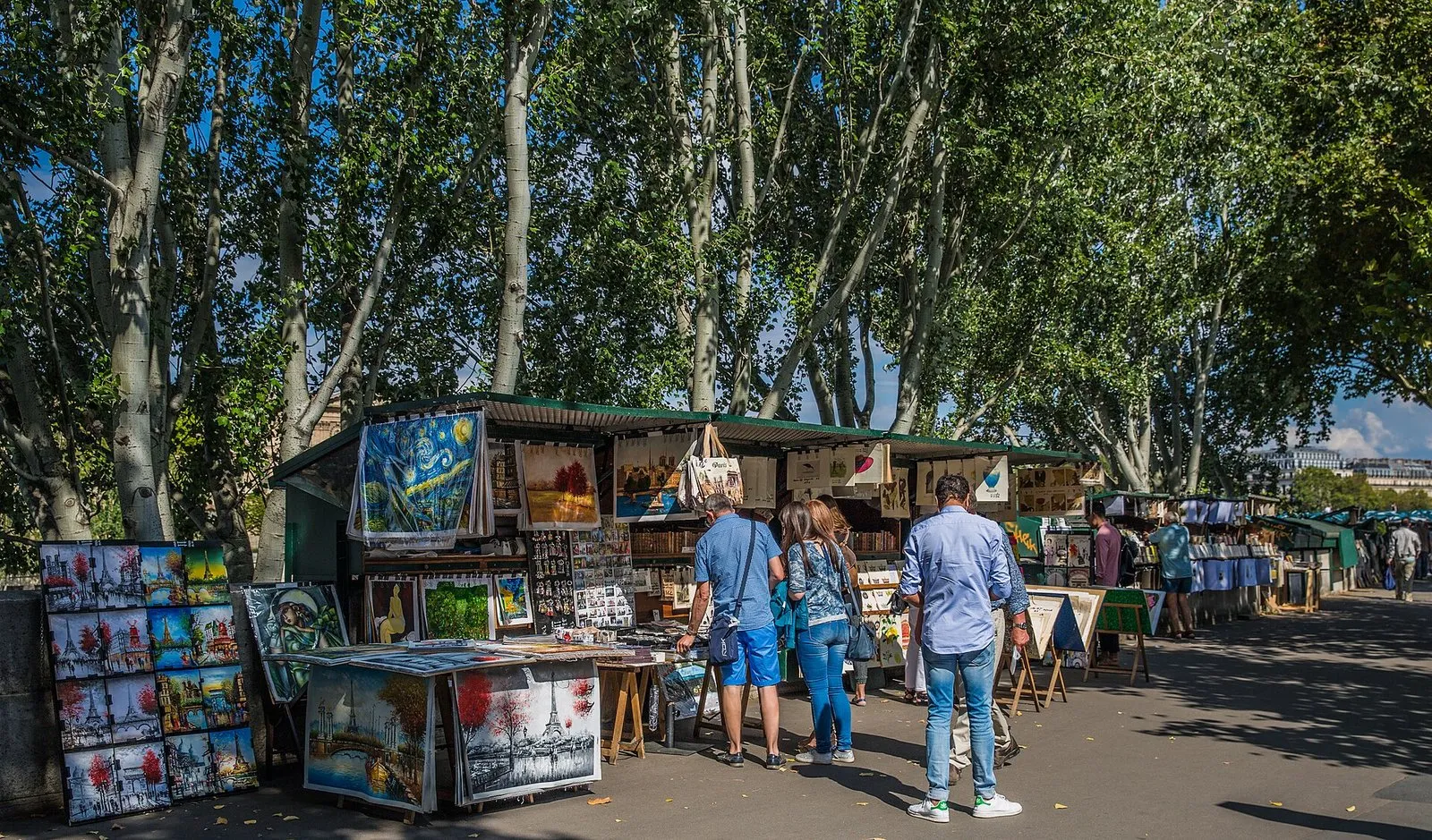
Photo: Ninara, CC BY 2.0, via Wikimedia Commons

Opening hours: the honest answer
The question has no single answer. Every bouquiniste chooses days and hours, and the one official rule is to open at least four days a week, bad weather aside. Nothing guarantees that a given box is open on the day of your visit.
A short history, with dates
- Sixteenth century. The forerunners, pedlars and “estaleurs”, already sold books on the quays and the Pont-Neuf. In 1649, under pressure from the booksellers, a regulation banned book stalls on the bridge.
- 1859. The first regulation specific to the bouquinistes is dated 10 October.
- 1891. The present boxes are made official; an order allows the bouquinistes to leave their stock on site overnight.
- About 1900. One colour is imposed, and the open lid may not rise above 2.10 m. At the Universal Exhibition of 1900 there were already 200 bouquinistes.
- 1943. Each bouquiniste is given 8 m of parapet and up to four boxes. There is no tax or rent, but the authorisation lasts five years. Souvenirs and small bric-à-brac are limited to one box.
- 2019 and 2024. The trade is listed on France’s inventory of intangible heritage on 6 February 2019, according to Wikipedia, and the Olympic removal plan is dropped in February 2024.
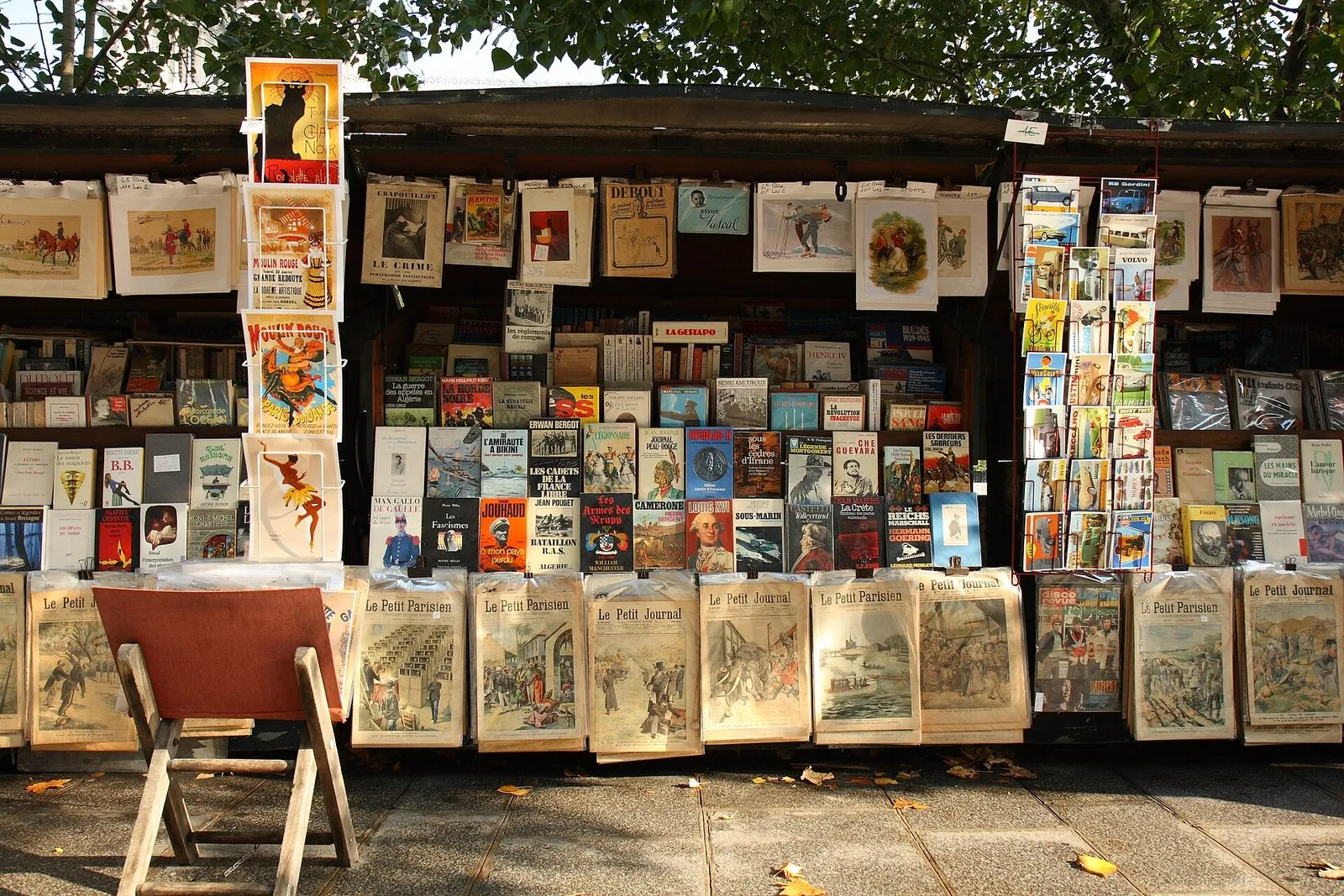
Photo: Benh LIEU SONG, CC BY-SA 3.0, via Wikimedia Commons

The word itself comes from the Flemish “boeckin”, a little book, and “bouquiniste” first appears in the Dictionnaire de Trévoux in 1752. Vacant places are given by the City after a call for applications: in March 2022, 17 new bouquinistes were chosen from 71 applicants.
Reaching the Left Bank boxes
From the quai de Montebello, Maubert-Mutualité on line 10 is the nearer station, at about 200 metres against 270 for Saint-Michel Notre-Dame. The Saint-Michel station on line 4 is shut until 19 December 2026, so use the RER B or C at Saint-Michel Notre-Dame. For a bed within walking distance, compare the hotels near Notre-Dame and the hotels near Saint-Michel. For the other kind of book trade, see the Shakespeare and Company bookstore.
Choosing your moment
Because each bouquiniste sets his or her own days, the useful question is not what time the boxes open but how to improve your odds. The one official rule, at least four days a week except in bad weather, means that on any given day some boxes are shut and others open. Bad weather is the stated exception, so a wet day may leave many lids closed. A walk of a kilometre or more along the quais, rather than a trip to one named box, lets you see whichever stalls are open on that day. The City of Paris publishes no shared timetable, and we found no official source for the often-quoted “from 11 a.m. to sunset”, so we do not repeat it.
What a box looks like, and what it may sell
The boxes follow a fixed size. According to Wikipedia, a box is 2 metres long and 0.75 metre wide, 0.60 metre high on the Seine side and 0.35 metre on the quai side. The dimensions were fixed in 1930 and renewed by a municipal order of 1 October 1993. With 8 metres of parapet and up to four boxes, a bouquiniste can use as much as 8.60 metres. The lid, once raised, may not exceed 2.10 metres above the ground, a rule the City dates to about 1900 so that the lids do not block the view of the river.
The trade is books, prints, magazines and old papers. Only one box in four may hold souvenirs and small bric-à-brac, so most of what you see is paper. Wikipedia counts around 900 boxes and, for 2013, 217 bouquinistes, while the City of Paris speaks of more than 200 bouquinistes and some 300,000 books on three kilometres of quais. The two figures fit together: each bouquiniste may run up to four boxes.
Who can become a bouquiniste
When a place falls vacant, the City of Paris calls for applications and chooses among them; in March 2022, 17 new bouquinistes were selected from 71 applications. The authorisation lasts five years, renewable, with no rent and no tax. Wikipedia lists the documents of an application: a covering letter, a CV, proof of address, a criminal-record extract and a business registration. The concessions themselves date from 1859.
The association and the UNESCO file
The Association culturelle des bouquinistes de Paris, created in 2009, said in 2024, according to the City of Paris, that it intended to take up again the file for inscription on UNESCO’s list of intangible heritage. As of 4 October 2026, UNESCO’s list of files under process for 2026 contains no French file on the bouquinistes: the French files are the Biou of Arbois and an extension of the transhumance entry. That is why we write that the trade is on France’s national inventory and not on a UNESCO list.
Combining the quais with the rest of the quarter
The distances below are measured as the crow flies from the point on the quai de Montebello that the City’s transport data places opposite Notre-Dame, and the walking times follow the site’s method (direct distance × 1.3 at 80 metres a minute).
- Shakespeare and Company: 101 metres, under 2 minutes on foot.
- Notre-Dame cathedral: 138 metres, about 2 minutes.
- Place Maubert: 183 metres, about 3 minutes.
- Rue de la Huchette: 208 metres, about 3 minutes.
- Saint-Séverin church: 215 metres, about 3 minutes.
- Place Saint-Michel: 355 metres, about 6 minutes.
- Cluny Museum: 381 metres, about 6 minutes.
- Panthéon: 684 metres, about 11 minutes.
The stretch west of Saint-Michel continues along the quai des Grands-Augustins and the quai de Conti towards the pont Royal, which is the other end of the Left Bank run.
Frequently asked questions
What time do the bouquinistes open?
There is no fixed time. The City of Paris publishes no common hours; each bouquiniste must open the box at least four days a week, except in bad weather. Opening times quoted elsewhere as “from 11 a.m. to sunset” are not in any official source we read.
Are the bouquinistes open on Sunday?
It depends on the box. Because the rule is four days a week, no day is guaranteed, and the City gives no weekly closing day.
How many bouquinistes are there?
More than 200 along about 3 km of quays, with some 300,000 books, according to the City of Paris in March 2025. Wikipedia gives around 900 boxes and 230 bouquinistes for 2022, a figure we treat with caution.
Were the bouquinistes moved for the 2024 Olympics?
No. In July 2023 the police prefect had planned to remove the boxes inside the opening-ceremony perimeter, about 570 boxes or 59 per cent of the total. The State dropped the plan in February 2024.
Are the bouquinistes on the UNESCO list?
No. Their know-how has been on France’s inventory of intangible cultural heritage since 2019, but the City of Paris says they were wrongly linked, from 1991, to the UNESCO inscription of the banks of the Seine. We found no French bouquinistes file among the 2026 UNESCO files.
Why are the boxes green?
Around 1900 a single colour was imposed, “vert wagon”, the green of the first metro, the Wallace fountains and the Morris columns.
How big is a bouquiniste’s box?
About 2 metres long and 0.75 metre wide, 0.60 metre high on the river side and 0.35 metre on the quai side, according to Wikipedia. A bouquiniste may run up to four boxes along 8 metres of parapet.
What do the bouquinistes sell?
Old and second-hand books, prints, magazines and old papers. Souvenirs and small bric-à-brac are limited to one box in four.
How do you become a bouquiniste?
By applying when the City of Paris calls for candidates for vacant places. In March 2022, 17 were chosen from 71 applications, for five-year authorisations that carry no rent or tax.
What else is within five minutes of the Left Bank boxes?
From the quai de Montebello, Shakespeare and Company is about 100 metres away, Notre-Dame about 140 metres, and rue de la Huchette and Saint-Séverin about 210 metres, as the crow flies.