Our guides
Notre-Dame Paris
Notre-Dame de Paris since its reopening — free entry, the €16 tower tickets, opening hours, what to book and the metro stations to use. Checked October 2026.
The cathedral on the other side of the river
Notre-Dame stands on the Île de la Cité, in the 4th arrondissement, but its forecourt looks straight across the Petit-Pont to the Latin Quarter, and that is why this guide sits on the Left Bank. The building reopened to the public in December 2024, nearly five years and eight months after the fire. The official site describes it as a place of prayer open to all, freely and without charge, for 860 years; the 2026 visit keeps to that.
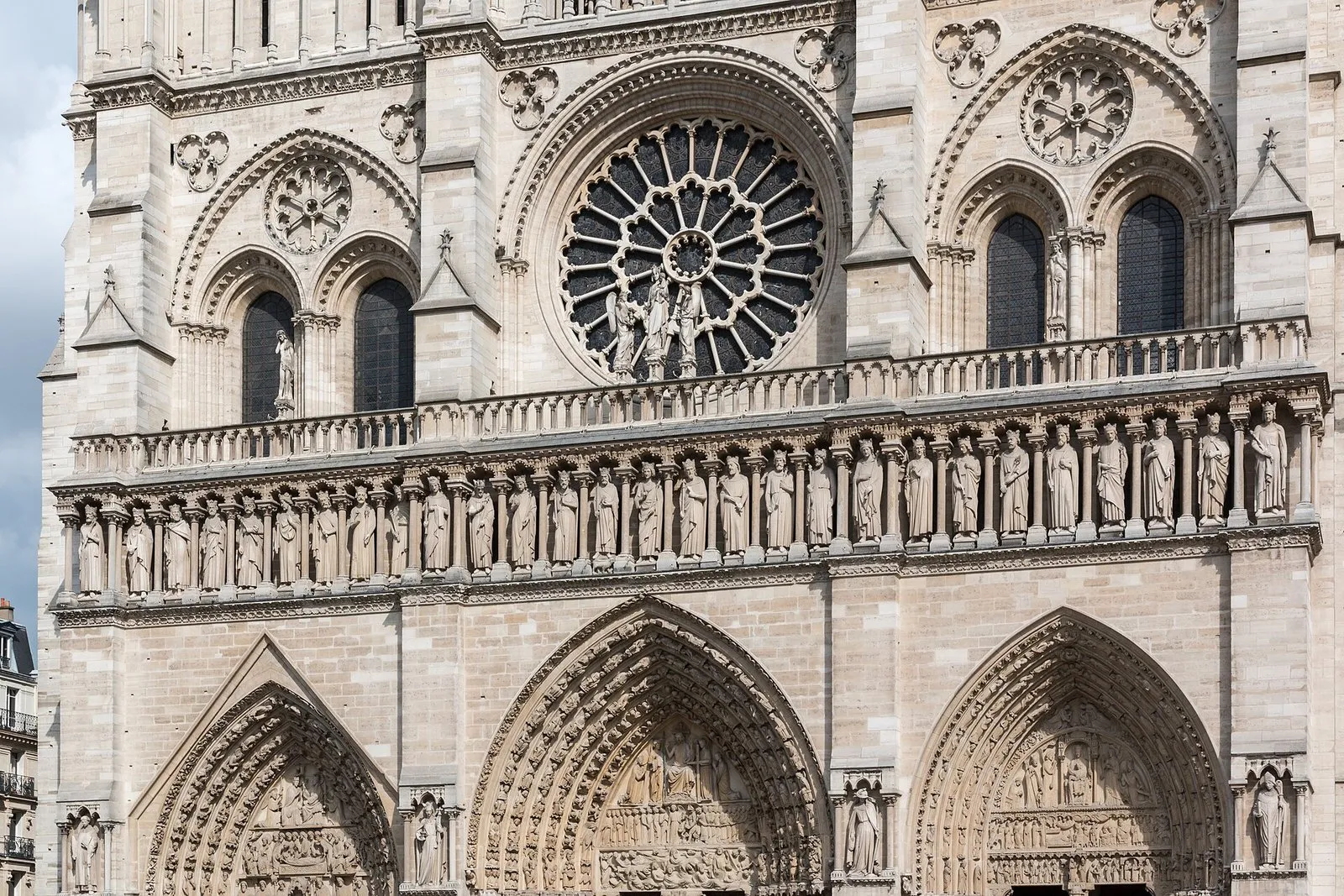
Photo: Dietmar Rabich, CC BY-SA 4.0, via Wikimedia Commons

Before you go: what the visit involves
- The nave. Free and open every day. The recommended free booking is made on the official site only.
- The towers. A separate visit, run by the Centre des monuments nationaux: 424 steps up to 69 metres, at a fixed time, with a named ticket. It has its own slot and its own ticket, separate from the cathedral.
- The Treasury. Paid at its own counter, with no online sale; on Thursdays it stays open until 8.30 p.m.
- The archaeological crypt. Under the forecourt at 7 place Jean-Paul II, it shows the remains of the Île de la Cité. It is closed on Mondays and is not accessible to visitors with reduced mobility.
- Rules at the door. According to the official visitor information, suitcases, scooters, food and telephones stay out of the building.
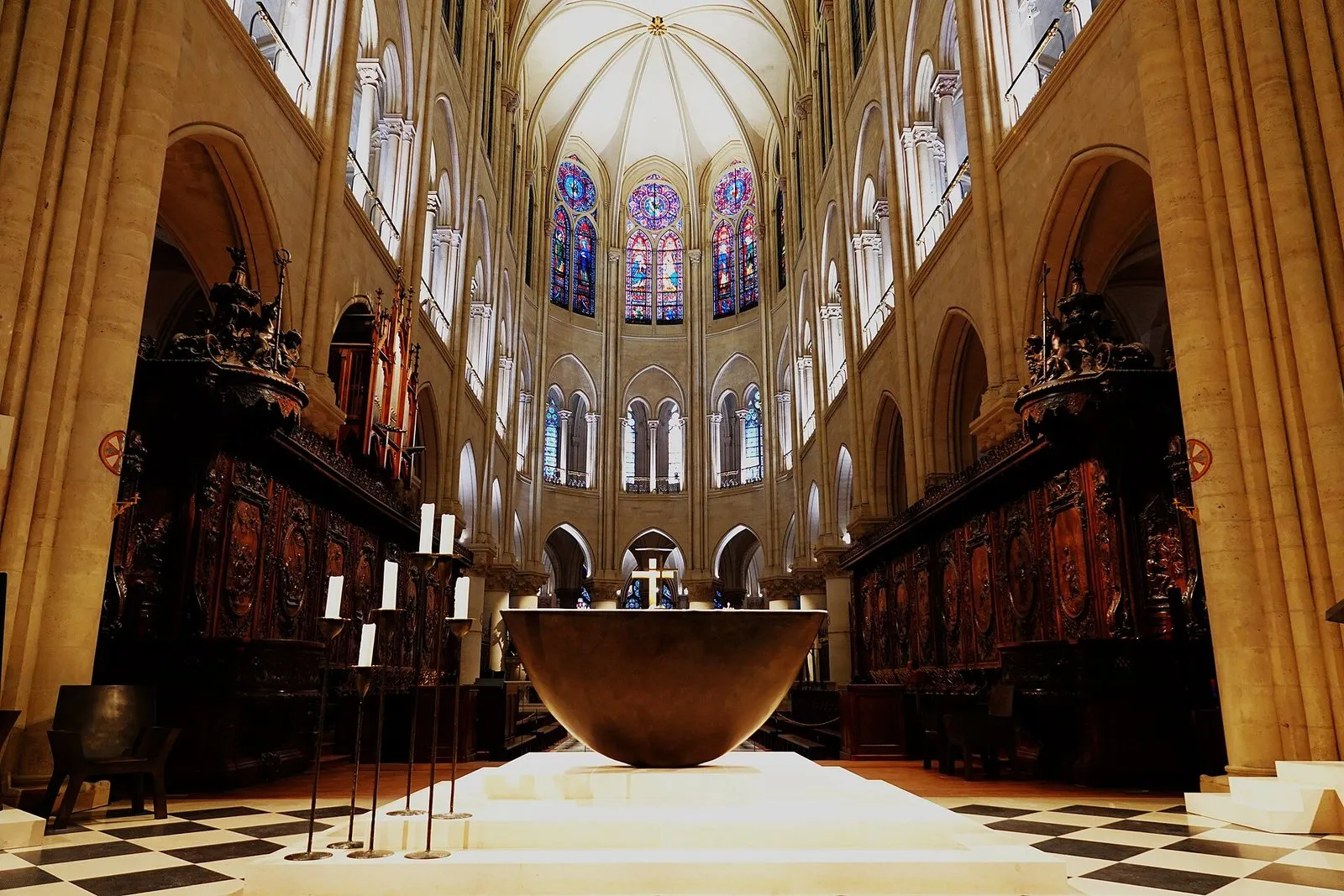
Photo: Ibex73, CC BY 4.0, via Wikimedia Commons

Getting there while line 4 is cut
The closure of Saint-Michel on line 4, from 14 September to 19 December 2026, lies five minutes’ walk from the forecourt. Use Cité on the same line, the RER B or C at Saint-Michel Notre-Dame, or Hôtel de Ville, as the City of Paris advises. On the Left Bank stand the Shakespeare and Company bookstore, about 120 metres from the forecourt, the bouquinistes along the quays, the church of Saint-Séverin and the rue de la Huchette.
What to look at
The west front is the part most visitors read first. It has three portals, dedicated to the Last Judgment, the Virgin and Saint Anne, according to Wikipedia. Inside, the nave is 128 metres long and 48 metres wide, by the same source, and the three great rose windows date from the thirteenth century: the west rose was completed in 1220, the north rose built in 1250 to 1260 and the south rose completed in 1270. The flying buttresses along the sides are those of the fourteenth century, which replaced the first ones with a reach of 15 metres between wall and counter-support. The great organ, built by François Thierry in the eighteenth century and now with more than 8,000 pipes, survived the fire but was damaged by water.
A fixed point of the building below ground is the pillar of the Boatmen, a Gallo-Roman monument discovered under the cathedral in 1710. The nineteenth-century spire, added in the restoration directed by Viollet-le-Duc from 1845 to 1867, was destroyed in the fire of 2019 together with the whole roof of the nave, choir and transept.
The fire and the reopening, in dates
- 1163. Construction begins under Bishop Maurice de Sully and ends around 1345.
- 1845 to 1867. Viollet-le-Duc directs the major restoration that adds the spire.
- 15 April 2019. The fire starts at 6.18 p.m., and the spire falls at 7.50 p.m., according to Wikipedia.
- 7 December 2024. The official reopening ceremony; the public follows the next day.
- 13 December 2024. The Crown of Thorns, deposited by Saint Louis, returns to the cathedral.
Wikipedia puts the reconstruction at three years, from 2021 to 2024. The official site is the place to check anything that changes, such as the schedule of masses.
Choosing your moment
Before the fire, Notre-Dame received between 12 and 14 million people a year, depending on whether one reads the English or the French Wikipedia article. The free online booking, which opens a few hours before the visit, is therefore the practical tool: the official site recommends it for people already in Paris, and entry without it remains possible with a longer wait. For a visit that includes the towers, book the slot first, since the towers cannot be entered without one, and build the rest of the day around it.
Two features of the timetable help planning. On Thursdays the cathedral stays open until 10 p.m. and the Treasury until 8.30 p.m., against 7 p.m. and 6 p.m. on the other weekdays. On Sundays the Treasury opens only from 1 p.m. to 5.30 p.m. The hours come from archived copies of the official site dated May to August 2026, so check them on the day.
Combining Notre-Dame with other visits
Distances are measured as the crow flies from the cathedral’s coordinates in our data, and walking times follow the site’s method (direct distance × 1.3 at 80 metres a minute).
- Shakespeare and Company: 139 metres, about 2 minutes.
- Rue de la Huchette: 236 metres, about 4 minutes.
- Saint-Séverin church: 309 metres, about 5 minutes.
- Cluny Museum: 497 metres, about 8 minutes.
- Sorbonne: 502 metres, about 8 minutes.
- Saint-Étienne-du-Mont: 705 metres, about 11 minutes.
- Institut du Monde Arabe: 749 metres, about 12 minutes.
- Panthéon: 818 metres, about 13 minutes.
The nearby quays are described in our guide to the bouquinistes.
Sleeping near the forecourt
The hotels in the section below are the ones of our base closest to the forecourt, measured in a straight line. For the longer comparison, see our list of hotels near Notre-Dame; for the district as a whole, start from the Latin Quarter guide.
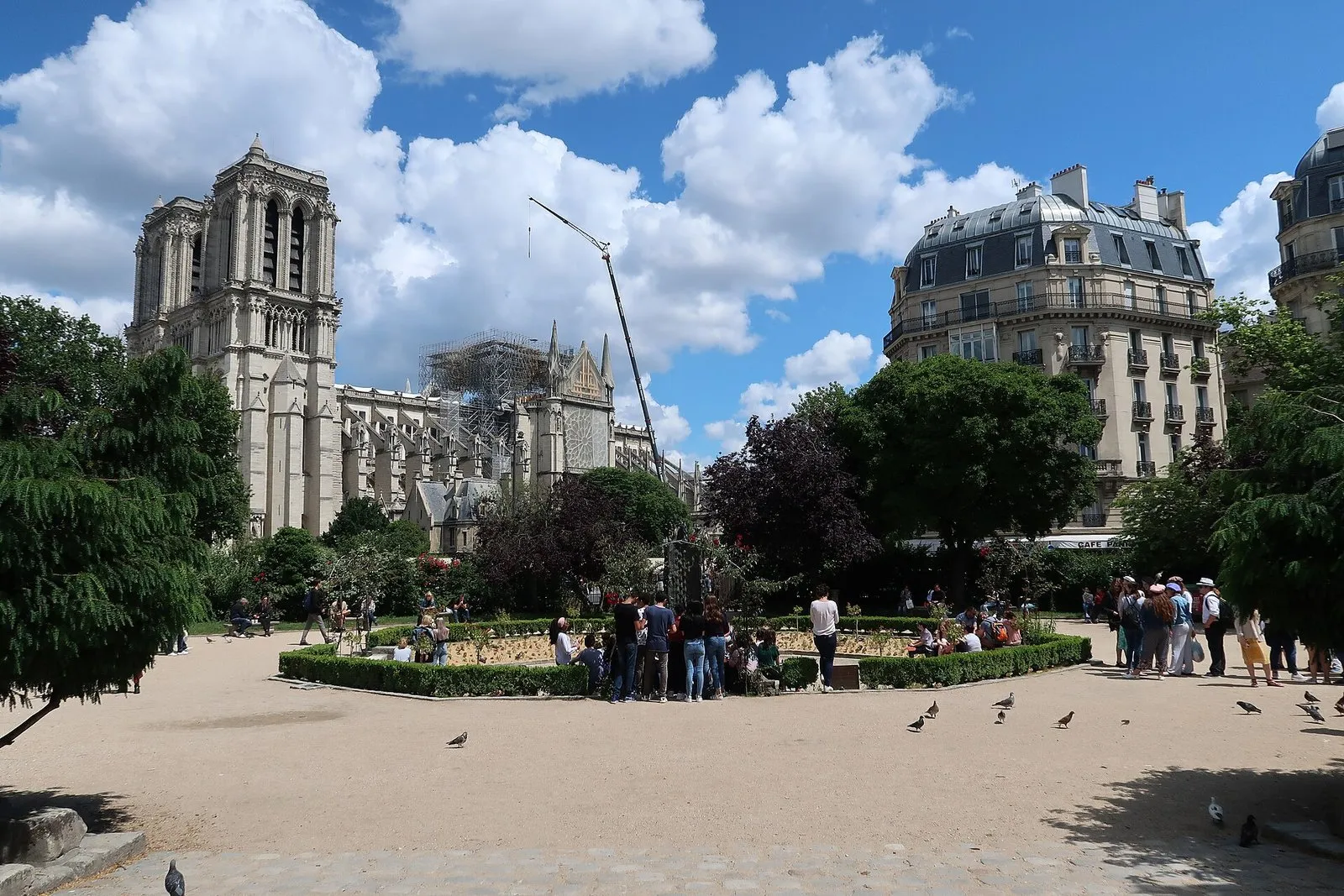
Photo: Celette, CC BY-SA 4.0, via Wikimedia Commons

History and distinctive features
- Construction began in 1163 under Bishop Maurice de Sully and lasted nearly two centuries, to about 1345. Source : fr.wikipedia.org
- Between 1845 and 1867 Eugène Viollet-le-Duc directed a major restoration that added a new spire. Source : fr.wikipedia.org
- The fire of 15 April 2019 destroyed the spire and the whole roof of the nave, choir and transept. The official reopening ceremony took place on 7 December 2024. Source : fr.wikipedia.org
- A free guided tour, run by the association CASA for up to 20 people, leaves every weekday at 2.30 p.m. from the foot of the north tower, at the corner of rue du Cloître-Notre-Dame and rue d’Arcole. Source : notredamedeparis.fr
Hotels near Notre-Dame
Other hotels
- Hôtel Esmeralda ★ 2 min walk · 150 m
- Hôtel Notre Dame Saint-Michel ★★★ 3 min walk · 200 m
- Maison Colbert Meliá Collection ★★★★★ 3 min walk · 250 m
- Les Rives de Notre Dame ★★★★ 3 min walk · 250 m
- Hôtel Henri IV Rive Gauche ★★★ 4 min walk · 300 m
- Hôtel Les Degrés de Notre Dame ★★ 4 min walk · 300 m
Within 600 m as the crow flies, nearest first. Walking times are estimates: straight-line distance × 1.3, at 80 metres a minute, to the station, not to a specific exit.
Frequently asked questions
Is Notre-Dame free to visit in 2026?
Yes. Entry to the cathedral is free for everyone. Only the towers (€16 at the full rate), the Treasury (€12) and the archaeological crypt are separate visits, and the official site says that no outside platform may sell access to the cathedral itself.
Do you need to book to go inside Notre-Dame?
No, but the free online booking, which opens a few hours before the visit, shortens the wait; the official site recommends it for visitors who are already in Paris. Without it, entry remains possible through a longer queue.
How much are the Notre-Dame towers?
€16 at the full rate. The ticket is named and tied to a time slot, there is no sale on site, and nobody enters without a reservation. Free admission for under-18s and some other groups also requires a booked slot; when a slot’s free quota is used up, only paid tickets are offered.
How many steps lead up the towers?
424 steps on the way up, to a height of 69 metres, according to the towers’ official information page. Time at the top is limited to five minutes, and in poor weather part of the route may close without a refund.
What time does Notre-Dame close?
At 7 p.m. from Monday to Friday, with a late closing at 10 p.m. on Thursdays, and at 7.30 p.m. at weekends; the last entry is 30 minutes earlier. These hours come from archived copies of the official site dated May to August 2026.
Which metro station is best, with Saint-Michel closed?
Cité on line 4 is the nearest, about 245 metres away. The RER B and C platforms at Saint-Michel Notre-Dame stay open, and Maubert – Mutualité on line 10 is about 327 metres away. Only the line 4 station of Saint-Michel is shut, until 19 December 2026.
Is there a service I can attend?
Yes. In August 2026 the cathedral listed masses at 8 a.m., noon and 6 p.m. on weekdays, with vespers at 5.30 p.m., and on Sundays masses at 8.30 a.m., 11.30 a.m. and 6 p.m., a Gregorian mass at 10 a.m. and vespers at 5.15 p.m. Access to masses is through a dedicated queue that opens 20 minutes before.
How long is the nave of Notre-Dame?
128 metres long and 48 metres wide, according to Wikipedia.
When did the spire fall in the 2019 fire?
At about 7.50 p.m. on 15 April 2019; the fire had started at 6.18 p.m., according to Wikipedia.
How many visitors did Notre-Dame receive before the fire?
Between 12 and 14 million a year, depending on whether one reads the English or the French Wikipedia article.
What is within ten minutes’ walk of Notre-Dame?
Shakespeare and Company (139 metres as the crow flies), rue de la Huchette (236), Saint-Séverin (309), the Cluny Museum (497) and the Sorbonne (502).