Our guides
Institut du monde arabe, Paris
The Arab World Institute (IMA) on the Seine — museum hours, €10 tickets, free under 26, the free rooftop terrace facing Notre-Dame and current shows. Checked October 2026.
A Seine-side institute with a metal skin
The Institut du monde arabe, or IMA, brings together a museum of 2,400 m² on three levels, temporary exhibitions, a library, a language centre and a terrace. The museum runs from Antiquity to contemporary creation. Its address is 1 rue des Fossés-Saint-Bernard, on the place Mohammed-V. The south façade, with its 240 moucharabiehs, is the best-known feature of a building designed by Jean Nouvel and Architecture-Studio.
What to see in autumn 2026
- The terrace. Free, with a view towards the east end of Notre-Dame.
- “Vive la mariée !”. The exhibition with its own ticket, on levels −1 and −2.
- The museum show. “Tenter l’art pour soigner”, on level 5 until 3 January 2027, on the museum ticket.
- The library. Home to a free photographic exhibition by Joss Dray on Palestine until 1 November, from 1 p.m. to 7 p.m. except Monday.
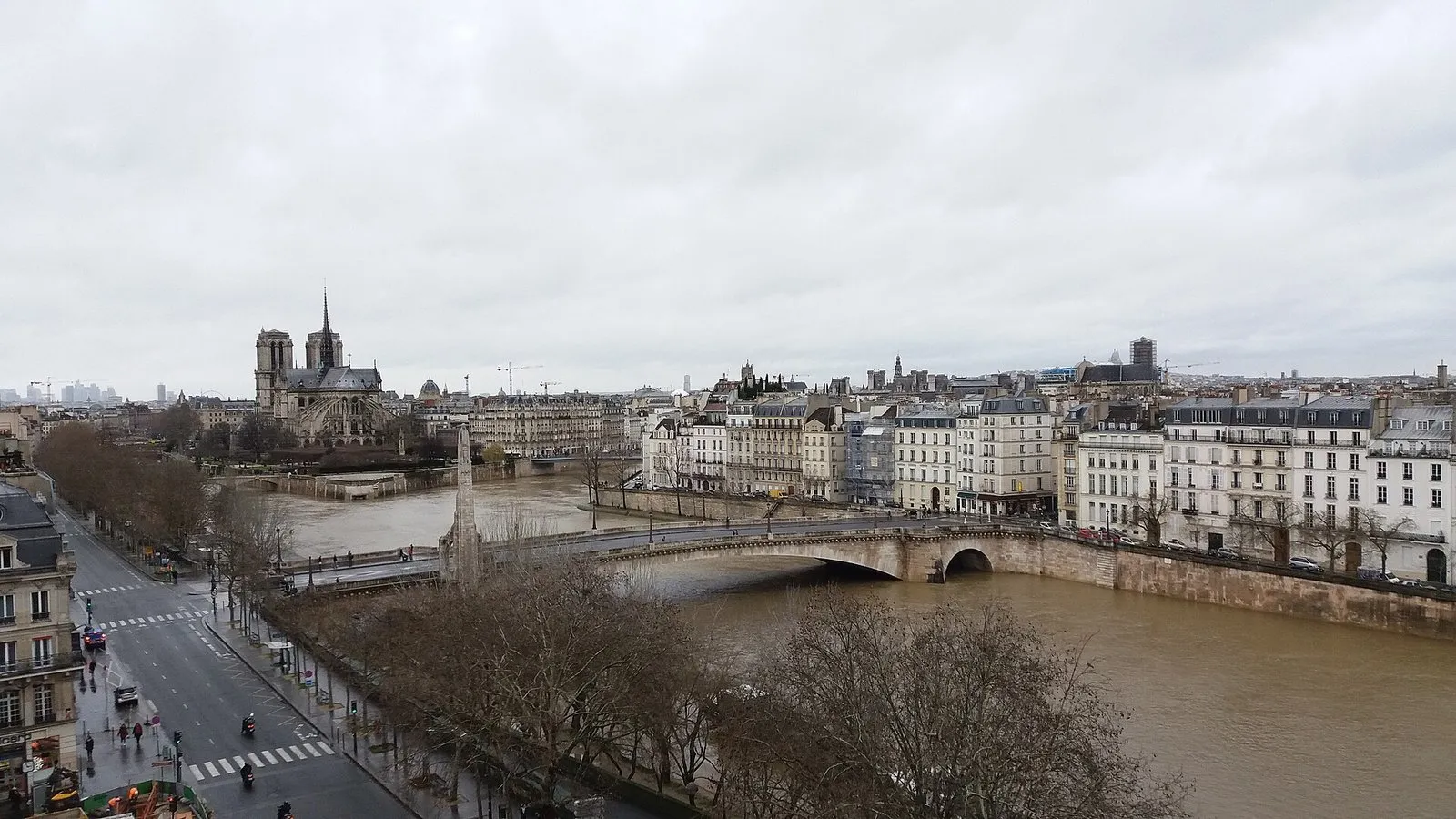
Photo: Romainbehar, CC0, via Wikimedia Commons

How the institute came about
According to Wikipedia, the foundation act of the Institut du monde arabe was signed on 28 February 1980, the first stone was laid in 1982, and François Mitterrand inaugurated the building on 30 November 1987. The building is about 75 metres long. Its architects, in the list we give above, won the Équerre d’argent in 1987. Inside, the library, renamed the Leïla Shahid Library in 2026, offers 150 seats in three reading rooms, again according to Wikipedia. The museum’s collection includes the donation of Claude and France Lemand, 1,600 works by contemporary Arab artists.
What to look at
Start outside. The 240 metal moucharabiehs of the south façade are the building’s signature: their diaphragms were meant to open and close with the sun through photoelectric cells, and Wikipedia says the movement now happens at each change of the clock. The north façade carries the mural painted in June 2014 by the artist eL Seed. Inside, the spiral “tower of books” of the library refers to the minaret of the Great Mosque of Samarra, and the hypostyle hall to the colonnades of the mosque of Córdoba.
The panoramic terrace needs no ticket. The institute describes “a spectacular view of the east end of Notre-Dame and of the whole Right Bank of the capital”, with free access Tuesday to Sunday. Its hours differ between pages of the institute’s site, as we note in the practical block.
Choosing your moment
The museum and exhibitions open Tuesday to Friday from 10 a.m. to 6 p.m. and at weekends and on public holidays until 7 p.m., with the tills closing 45 minutes earlier; the institute is shut on Monday and on 1 May. The library opens from 1 p.m. to 7 p.m. Tuesday to Sunday. Visiting on a weekday ends an hour earlier than a visit at the weekend, which matters if you want to see both the museum and an exhibition. The 2025 count of 730,839 visitors, with 142,456 museum entries, shows that most visits are not to the museum alone: terrace, exhibitions, library and restaurant make up the rest. Wikipedia gave 239,782 visitors for 2019, a figure counted on another basis, so we do not compare the two.
Getting there
Jussieu (lines 7 and 10) is about 343 metres away as the crow flies, Sully – Morland (line 7) about 446 metres, Cardinal Lemoine (line 10) about 468 metres and Pont Marie (line 7) about 520 metres. The institute’s own page adds bus lines 63, 67, 86, 87 and 89, and a car park open 24 hours a day at 1 rue des Fossés-Saint-Bernard, with places for visitors with reduced mobility on the esplanade. It describes access for visitors with disabilities as facilitated.
Combining the institute with other visits
Distances are as the crow flies from the institute, with walking times by the site’s method (direct distance × 1.3, at 80 metres a minute).
- Ménagerie of the Jardin des Plantes: 453 metres, about 7 minutes.
- Arènes de Lutèce: 542 metres, about 9 minutes.
- Jardin des Plantes: 591 metres, about 10 minutes.
- Saint-Étienne-du-Mont: 742 metres, about 12 minutes.
- Natural History Museum: 747 metres, about 12 minutes.
- Place de la Contrescarpe: 747 metres, about 12 minutes.
- Notre-Dame cathedral: 749 metres, about 12 minutes.
- Grand Mosque of Paris: 788 metres, about 13 minutes.
Eating and staying nearby
For the institute’s restaurant, see our page on the IMA restaurant. In a straight line from the institute, the points we hold for the arènes de Lutèce and the Jardin des Plantes are about 520 and 580 metres away, and the Grand Mosque of Paris about 790 metres.
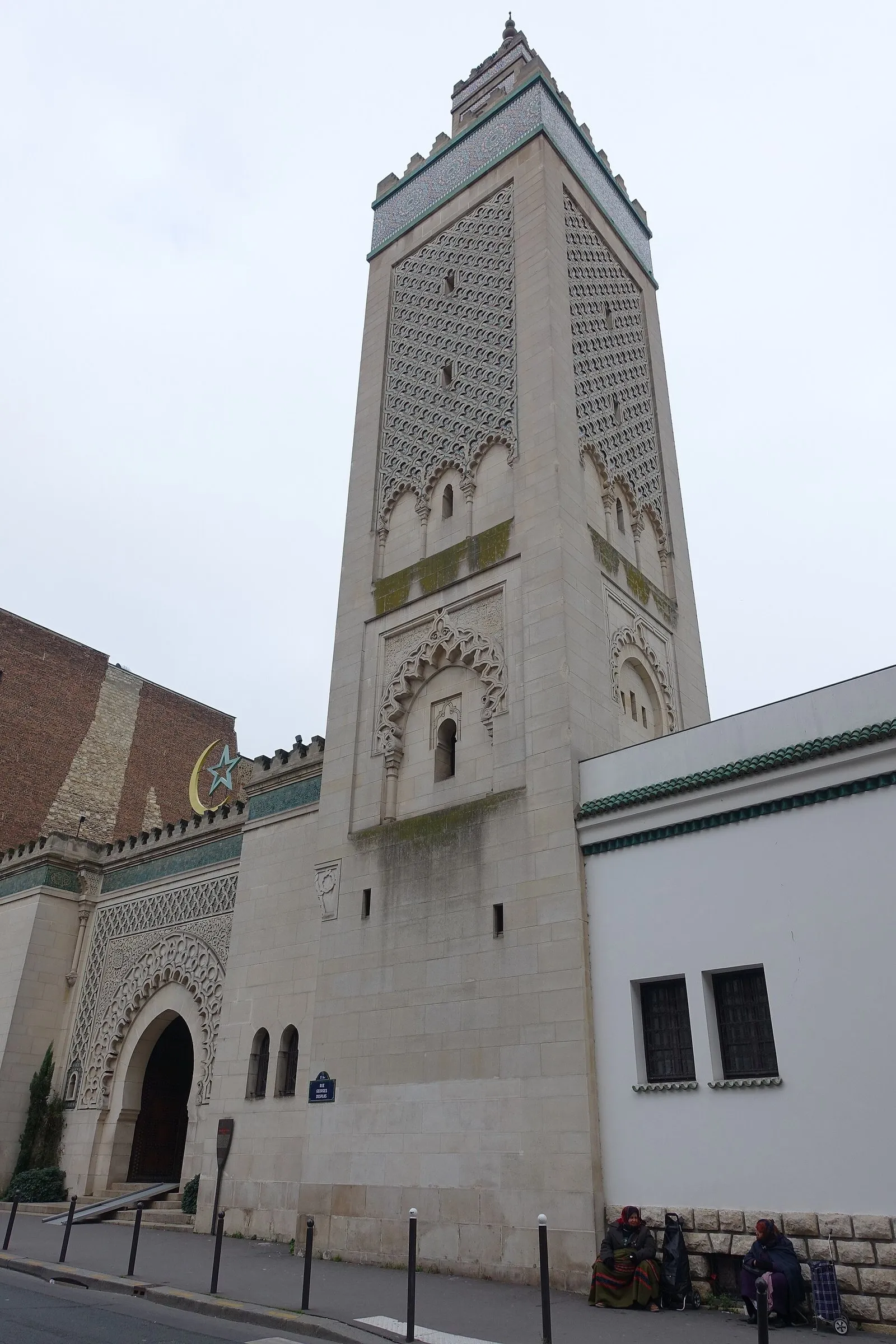
Photo: Guilhem Vellut, CC BY 2.0, via Wikimedia Commons

The closest hotels in our database, measured in a straight line from the institute, are these:
- Hôtel Pilgrim, four stars, about 320 metres.
- Paris Art Hotel, three stars, about 375 metres.
- Hôtel Quartier Latin, three stars, about 415 metres.
- Hôtel Familia, two stars, about 420 metres.
- Hôtel Minerve, three stars, about 430 metres.
- Hôtel Vendôme Saint-Germain, three stars, about 440 metres.
Stars are those of the Atout France register, as recorded in our database. For a wider choice, see our list of hotels near the Jardin des Plantes.
History and distinctive features
- The institution was founded in 1980 by France and Arab states; its building, on the Seine facing the Île Saint-Louis, has welcomed the public since December 1987. Source : imarabe.org
- The south façade has 240 metal moucharabiehs whose diaphragms were meant to open and close with the sunlight by means of photoelectric cells; they were restored in 2017. According to Wikipedia, they now move at each change of the clocks. Source : fr.wikipedia.org
- The building stands on the site of the former Porte Saint-Bernard, the abbey of Saint-Victor and the wine market. Inside, the spiral “tower of books” of the library recalls the minaret of the great mosque of Samarra, and the hypostyle hall the colonnades of the mosque of Córdoba. Source : imarabe.org
- The building received the Équerre d’argent in 1987 and an Aga Khan Award for Architecture (1987–1989 cycle), according to Wikipedia. Source : fr.wikipedia.org
- In June 2014 the Franco-Tunisian artist eL Seed painted a monumental fresco on part of the north façade. Source : fr.wikipedia.org
Frequently asked questions
What are the opening hours of the Institut du monde arabe?
Tuesday to Friday, 10 a.m. to 6 p.m., and at weekends and on public holidays 10 a.m. to 7 p.m., with the tills closing 45 minutes earlier. It is closed on Mondays and on 1 May.
How much is entry to the museum?
€10 for visitors over 26, €7 for a group of friends of six to nine, and free for under-26s, who must collect a token at the reception. The “Vive la mariée !” exhibition has its own ticket at €12, or €15 jointly with the museum.
Is the terrace free?
Yes. The panoramic terrace and the shop are open to all without a ticket. The terrace looks towards the east end of Notre-Dame and closes in bad weather.
What is on in October 2026?
“Vive la mariée ! Algérie, Maroc, Tunisie”, from 29 September 2026 to 28 February 2027, with about forty costumes and adornments never shown in France and 27 contemporary artists; “Tenter l’art pour soigner”, until 3 January 2027; and a free photography exhibition in the library, until 1 November.
Is the museum closing for the new display?
A “Nouveau Musée”, a full redesign of the permanent collection, is planned to open in 2028. No closing calendar for the galleries was published on the pages we read.
Which station is nearest?
Jussieu, on lines 7 and 10, about 343 metres away. Sully – Morland and Cardinal Lemoine are around 450 metres away. The Saint-Michel platforms of line 4 are closed until 19 December 2026, which does not affect this route.
How many people visit?
In 2025 the institute counted 730,839 visitors, of whom 142,456 entered the museum.
When was the Institut du monde arabe inaugurated?
On 30 November 1987 by François Mitterrand, according to Wikipedia. The foundation act dates from 28 February 1980 and the first stone from 1982.
Which buses serve the Institut du monde arabe?
Lines 63, 67, 86, 87 and 89, according to the institute, which also has a car park open 24 hours a day.
Is the Institut du monde arabe accessible to wheelchair users?
The institute describes access for visitors with disabilities as facilitated, with reserved places for visitors with reduced mobility on the esplanade.
What does the south façade’s moucharabieh do?
The 240 metal moucharabiehs have diaphragms meant to open and close with the sunlight; according to Wikipedia, they now move at each change of the clock.