Our guides
Saint-Étienne-du-Mont, the church behind the Panthéon
Saint-Étienne-du-Mont in the 5th — free entry, opening hours, the only stone rood screen left in Paris, the shrine of Saint Geneviève, metro and nearby hotels. Checked October 2026.
A church built against an abbey
Saint-Étienne-du-Mont stands on the place Sainte-Geneviève, behind the Panthéon, on the hill that bears the saint’s name. It was rebuilt between 1492 and 1626, in a style that moves from flamboyant Gothic to the Renaissance. For centuries it stood against the abbey church of Sainte-Geneviève; when that building was demolished in the early nineteenth century, only the Clovis tower survived, in what is now the lycée Henri-IV.
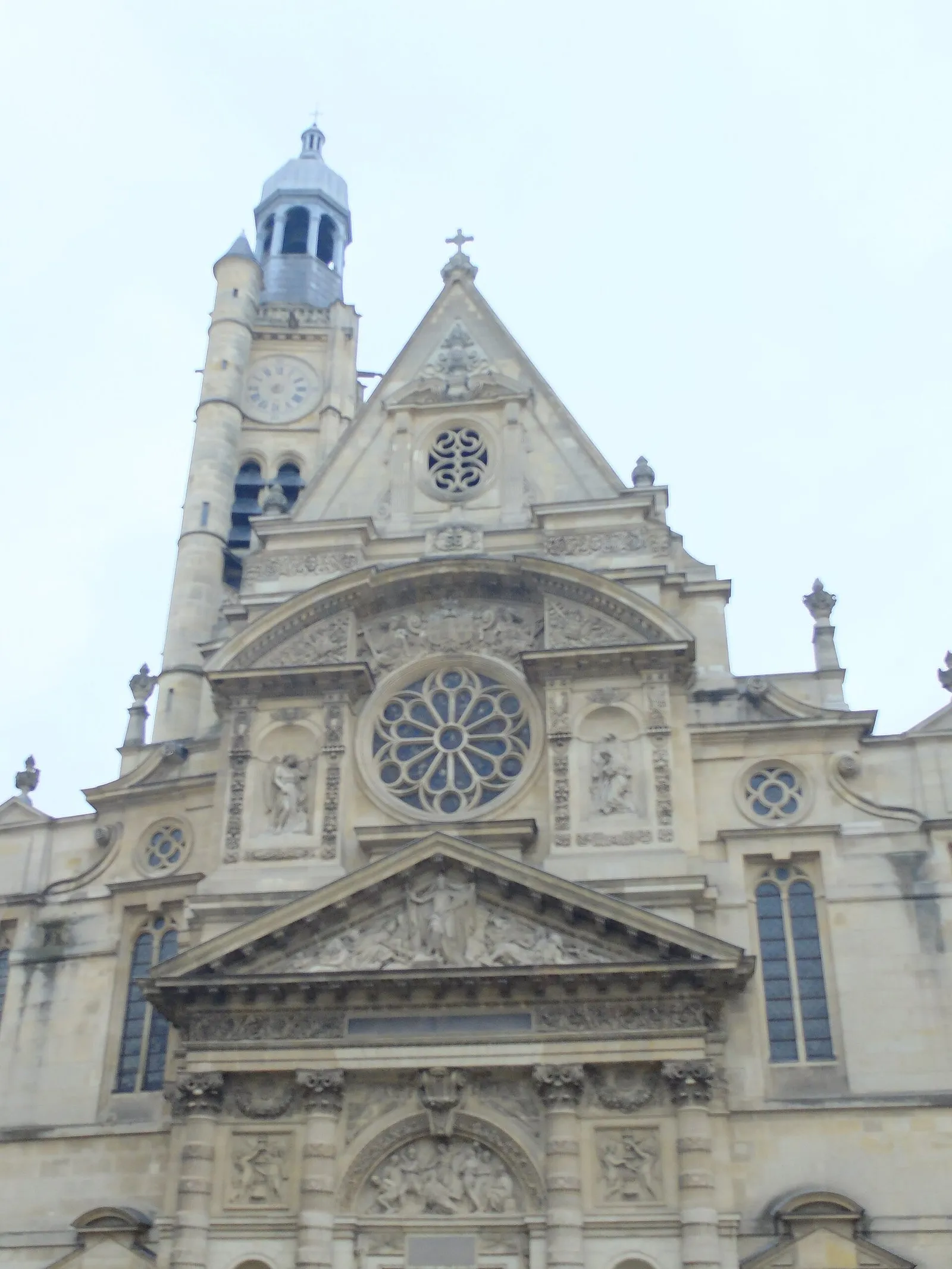
Photo: Wyslijp16, CC BY 4.0, via Wikimedia Commons

Inside, the plan is that of a hall church, 69 metres long and 25.5 metres wide, with a transept that does not project on the outside.
What to look for inside
The first thing is the rood screen. Built around 1530, it is Gothic in structure and Renaissance in ornament, with a balustrade of lace-like stone. Paris has no other.
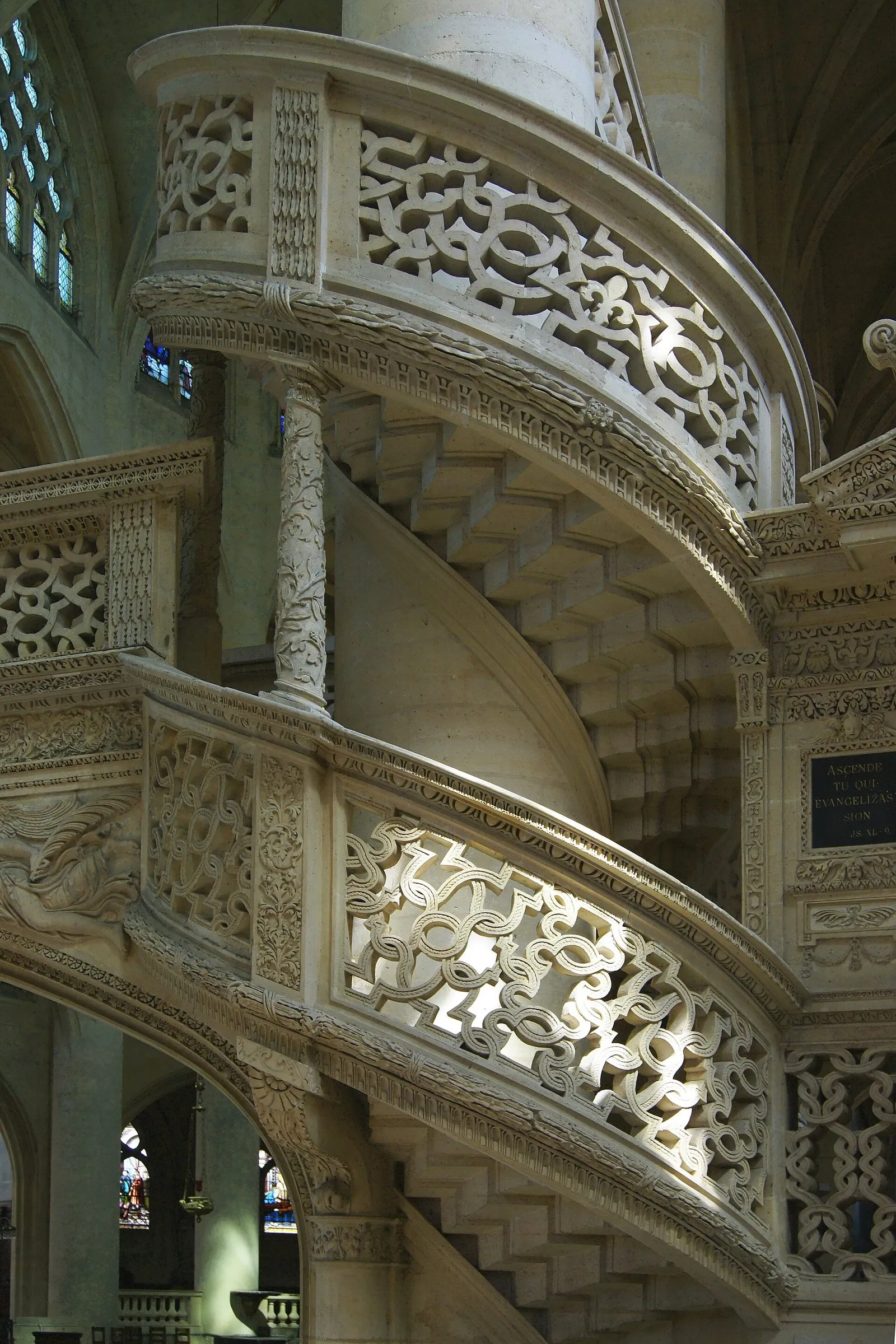
Photo: Jebulon, public domain, via Wikimedia Commons

The second is the shrine of Saint Geneviève, patron saint of Paris, empty of relics since the Revolution. The church also holds the tombs of Pascal, Racine and the painter Eustache Le Sueur, and an organ whose case dates from the 1630s.
The church is a working parish: you may not walk about during services, and on Mondays it opens only in the afternoon.
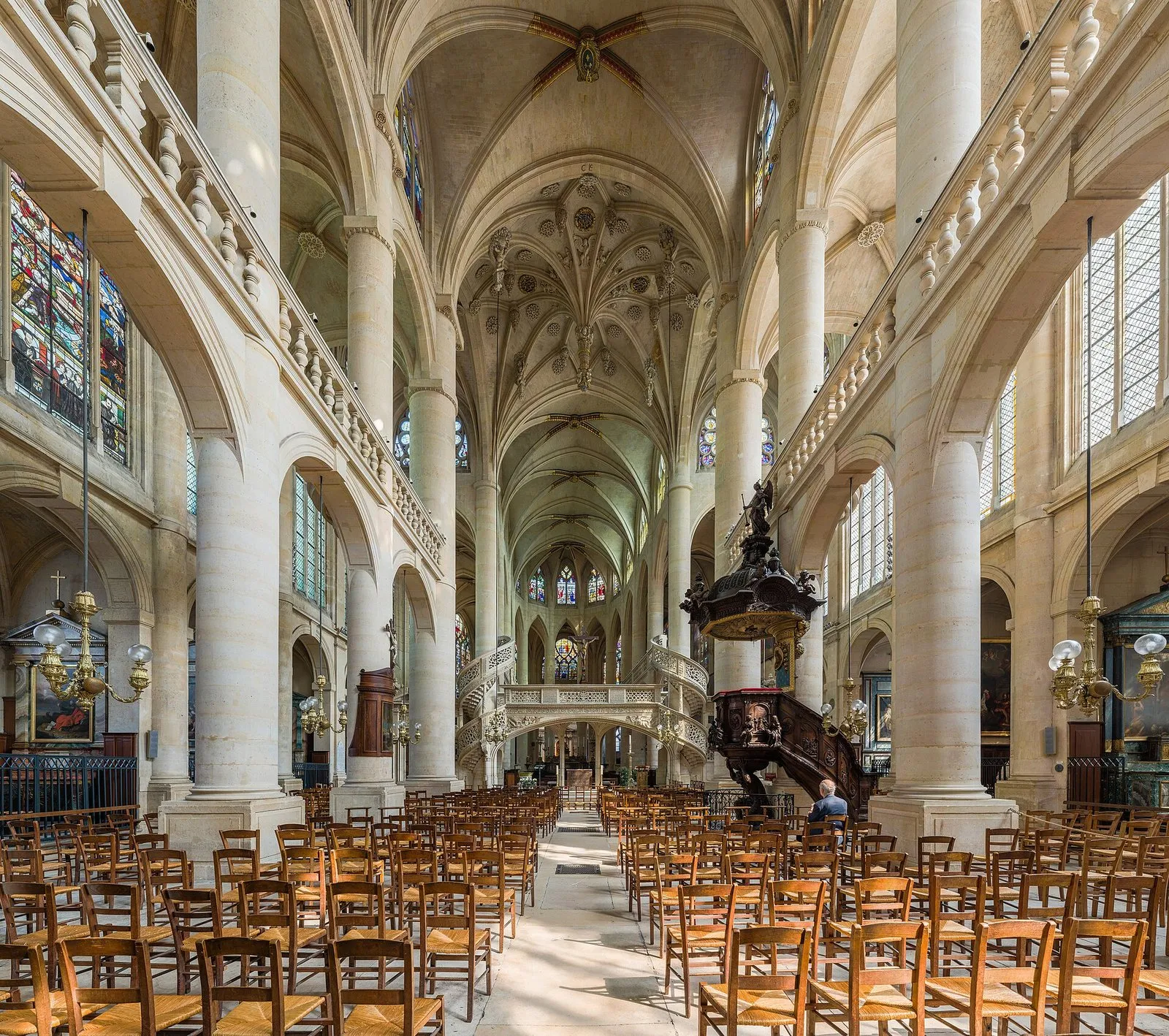
Photo: Diliff, CC BY-SA 3.0, via Wikimedia Commons

Reaching it in 2026
The nearest station is Cardinal Lemoine on line 10, about 305 metres away. Three more stations lie within about 550 metres, all as the crow flies: Maubert – Mutualité (about 378 m), Cluny – La Sorbonne (534 m) and Jussieu (550 m).
Choosing your moment
The church is open every day, with the longest hours on Sunday (8 a.m. to 8 p.m.) and the shortest on Monday, when the doors open only at 2.30 p.m. and close at 7.30. From Tuesday to Saturday it opens at 8 a.m., which makes the early morning the simplest time to see the nave without a service in progress. Because walking round is forbidden during services, a Sunday visit is best planned around the Masses listed on the parish website rather than the third-party directory we found them in.
Entry is free and needs no booking. The guided tours of the association Art, Culture et Foi, at 3 p.m. on 25 October, 15 November and 6 December, are the only fixed group visits the parish lists.
More to look at
- The west front. It was built between 1610 and 1622 and marks the passage from Gothic to the Renaissance; three levels, each in a different register, are visible from the place Sainte-Geneviève.
- The pendant keystone. In the middle of the transept, a keystone of three to four metres hangs down from the vault. It is one of the daring features Wikipedia singles out.
- The pulpit. The parish dates it to 1651, with sculptures by Lestocart after a design by La Hire; allegorical statues surround it.
- The stained glass. The parish describes a continuous set from the early sixteenth century to the first quarter of the seventeenth, mostly still where it was placed. The Communion chapel keeps 12 of the 22 enamel-painted windows of the late sixteenth or early seventeenth century.
- The organ case. Built in 1631, it is the oldest in Paris in its original state, according to the parish, with 7,000 pipes in 90 stops.
The cloister, put up in 1605–1609 on three sides, and the neo-Gothic chapel of Saint Geneviève, of 1853, are later additions to the same site. The axis of the choir is also slightly turned in relation to the nave, so the church does not run in a straight line from the door to the altar.
A long building site
The medieval abbey church had become too small for the parishioners in the thirteenth century, which is why a parish church was rebuilt beside it. Work began in the 1490s and the church was consecrated in 1626, a span of more than 130 years. That explains the mix: a Gothic structure, a rood screen of about 1530–1535, and a front that belongs to the early seventeenth century.
Tombs, relics and a tower
Three burials are documented. Blaise Pascal and Jean Racine lie in the church. Racine was moved there from the abbey of Port-Royal, in 1711 according to the data we hold; Pascal is buried here because he died in the parish. The painter Eustache Le Sueur is buried here too. The shrine of Saint Geneviève, patron saint of Paris, is empty, because the relics were destroyed during the Revolution.
Outside, the only trace of the neighbouring abbey church is the Clovis tower, which stands in the grounds of the lycée Henri-IV. The abbey church was pulled down in the early nineteenth century, and the shrine passed to Saint-Étienne, which now stands alone on the place Sainte-Geneviève, with the Panthéon at its back.
The parish and its saints
According to the parish, the site began with a church of Saints Peter and Paul, built in the time of Clovis and later an abbey. Saint Geneviève is therefore the thread of the visit, from the empty shrine to the former church of Sainte-Geneviève, now the Panthéon, 155 metres away. A second name belongs to the church’s modern history: Frédéric Ozanam founded the first Conference of the Society of Saint Vincent de Paul here in 1833, and was beatified by John Paul II in 1997.
Combining it with
The distances below are straight lines computed from the coordinates in our data; times follow our method (distance × 1.3, at 80 metres a minute).
| Place | Distance | On foot |
|---|---|---|
| Panthéon | 155 m | 3 min |
| Place de la Contrescarpe | 302 m | 5 min |
| Arènes de Lutèce | 398 m | 6 min |
| Sorbonne | 398 m | 6 min |
| Rue Mouffetard | 406 m | 7 min |
| Cluny Museum | 523 m | 8 min |
| Saint-Séverin | 593 m | 10 min |
Saint-Séverin, the other church of the quarter in our guides, is a ten-minute walk to the north-west.
Where to sleep nearby
Measured from the church, six hotels stand within about 225 metres: the Hôtel Résidence Henri IV (about 201 m), the Hôtel Atmosphères (206 m), the Hôtel des Grands Hommes (213 m), the Hôtel WYLD Saint Germain (217 m), Les Dames du Panthéon (221 m) and the Hôtel & Spa Saint-Jacques (222 m), all as the crow flies. For the hillside as a whole, see hotels near the Panthéon.
Continue with the Panthéon itself, or take the longer view in our Latin Quarter guide.
History and distinctive features
- The rood screen, built in the early sixteenth century (about 1530), is the only one that survives in Paris — Gothic in structure, Renaissance in ornament, with a lace-like stone balustrade. Source : saintetiennedumont.fr
- The present church was rebuilt between 1492 and 1626. It stood against the abbey church of Sainte-Geneviève, demolished in the early nineteenth century; only the Clovis tower, inside the lycée Henri-IV, remains. Source : saintetiennedumont.fr
- The plan is that of a hall church, 69 m long and 25.5 m wide, with a transept that does not project on the outside. Source : saintetiennedumont.fr
- The church keeps the shrine of Saint Geneviève, empty of relics since the Revolution, and the tombs of Pascal, of Racine (moved from Port-Royal in 1711) and of the painter Eustache Le Sueur. Source : fr.wikipedia.org
- It has been listed as a historic monument since the list of 1862, and the organ case dates from the 1630s. Source : fr.wikipedia.org
Frequently asked questions
Is Saint-Étienne-du-Mont free to visit?
Yes. It is a parish church and entry is free; only the guided tours run by the association Art, Culture et Foi may ask for a contribution, which the parish does not specify.
What are the opening hours of Saint-Étienne-du-Mont?
Monday from 2.30 p.m. to 7.30 p.m., Tuesday to Saturday from 8 a.m. to 7.30 p.m. and Sunday from 8 a.m. to 8 p.m., according to the parish website read on 4 October 2026. Visiting is not allowed during services.
What time is Mass at Saint-Étienne-du-Mont?
We do not quote times. The ones we found came from a third-party directory, not from the parish, so check the parish website before you plan around a service.
What is the rood screen?
A stone gallery across the church, once placed between nave and choir. This one, from about 1530, is the only one still standing in Paris.
Whose tombs are in the church?
Pascal, Racine and the painter Eustache Le Sueur. Racine was transferred from Port-Royal in 1711.
How far is it from the Panthéon?
It stands directly behind it. The Panthéon is covered on our own page, and both stand on the Montagne Sainte-Geneviève.
How long should I allow for Saint-Étienne-du-Mont?
The parish gives no figure. The church is small enough to see in the time it takes to look at the rood screen, the shrine of Saint Geneviève and the tombs; the Panthéon, 155 metres away, takes longer.
When was Saint-Étienne-du-Mont built?
Work began in the 1490s and the church was consecrated in 1626. The façade dates from 1610 to 1622 and the rood screen from about 1530–1535.
Is Saint-Étienne-du-Mont a historic monument?
Yes, it has been listed since 1862.
Can you take photographs inside?
The parish page we read does not say. Because it is a working church, walking round is forbidden during services, which is a safer rule to follow for the camera too.
What is left of the abbey of Sainte-Geneviève?
Only the Clovis tower, in the grounds of the lycée Henri-IV, behind the church. The abbey church was pulled down in the early nineteenth century and the shrine of the saint went to Saint-Étienne-du-Mont.
Is the organ of Saint-Étienne-du-Mont old?
The case was built in 1631, according to the parish, which calls it the oldest in Paris in its original state. The instrument has 7,000 pipes in 90 stops.