Our guides
Grand Mosque of Paris
The Grand Mosque of Paris — visiting hours, the €5 ticket, the 1926 centenary, what the mosque says of the Second World War, and hotels nearby. Checked October 2026.
A mosque built after the First World War
The Grand Mosque was inaugurated on 15 July 1926, after a project launched in the middle of the First World War to honour Muslim soldiers who died for France. It was built in four years by about 450 craftspeople from the Maghreb, who made its zellige tiles, stuccoes and cedar woodwork. Its minaret is 33 metres high, and it stands on the site of the former Pitié hospital.
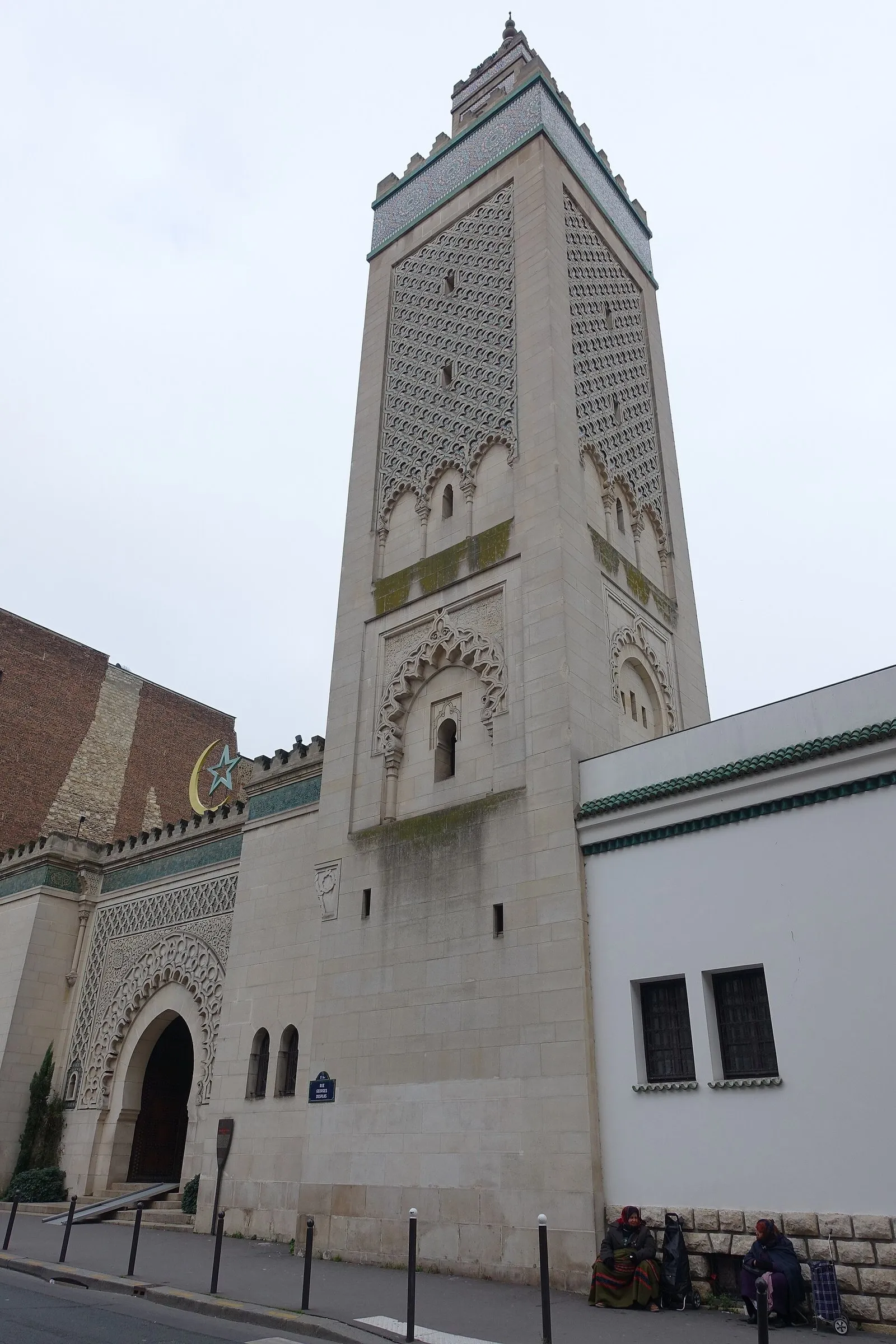
Photo: Guilhem Vellut, CC BY 2.0, via Wikimedia Commons

Visiting in 2026
The visit takes in the patio, the prayer hall and the gardens; the gallery of the Cour d’honneur leads to the tomb of the mosque’s first director and to plaques for the Muslim soldiers of both wars. Fridays are the day of the main prayer, so there are no visits. Over 25,000 people came for the European Heritage Days of 2026, according to the mosque.
The restaurant, the tea room and the hammam occupy a separate address, 39 rue Geoffroy-Saint-Hilaire, and are reached without a visit ticket. The restaurant’s hours differ between pages of its own website, so check them before you go.
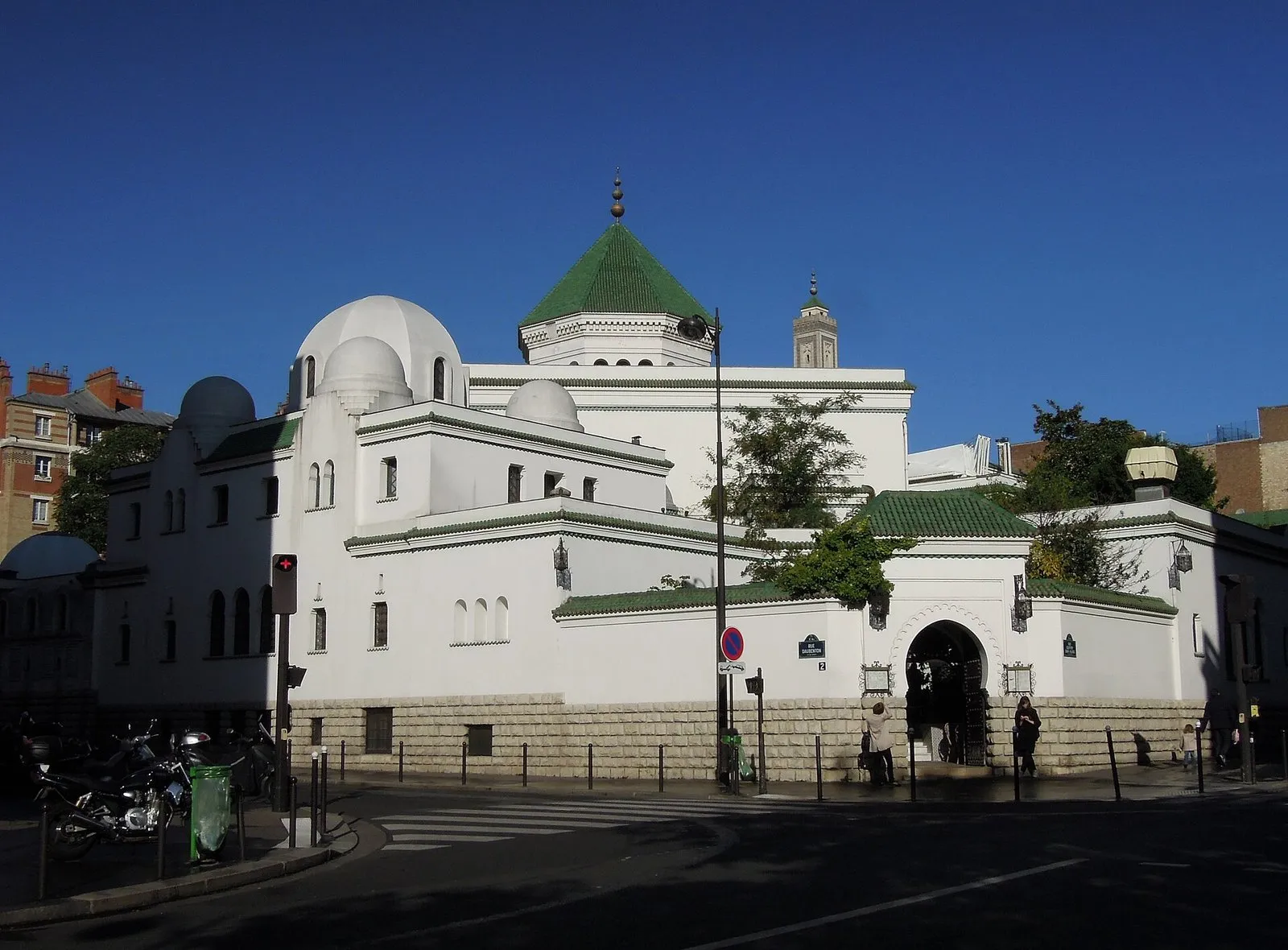
Photo: Cédric Sicot, CC BY-SA 3.0, via Wikimedia Commons

The Second World War
The mosque’s own account, on which our page relies, is that it served as a refuge during the Occupation, and it says itself that the number of people it protected is still to be determined. Historians question both the figures and the portrayal in the 2011 film Les Hommes libres. For this reason we repeat only what the institution claims, attributed to it.
Getting there
The mosque’s official address is 2 bis place du Puits-de-l’Ermite, and the main entrance was renamed 2, parvis Abdelkader-Mesli in 2021. The nearest stations, as the crow flies, are Place Monge on line 7 (228 metres), Censier – Daubenton on line 7 (313 metres), Jussieu on lines 7 and 10 (446 metres) and Cardinal Lemoine on line 10 (580 metres). The official page for the restaurant adds bus lines 24, 67 and 89 to the stop Buffon – La Mosquée, bus 91 to Saint-Marcel – Jeanne d’Arc, and the Gare d’Austerlitz station (lines 5 and 10), as well as a public car park at 15 rue Censier. Remember that the restaurant, tea room and hammam are on the other side of the block, at 39 rue Geoffroy-Saint-Hilaire.
What is in the building
According to Wikipedia, the mosque stands on about 7,500 square metres, of which 3,500 are gardens, and holds up to 1,000 people. Its style is Hispano-Moorish, “inspired by the Almohad current”, and its design is credited to Maurice Tranchant de Lunel, with Robert Fournez, Maurice Mantout and Charles Heubès responsible for the execution. Besides the prayer hall, the same article lists a library, a madrasa (school), a conference room, Andalusian gardens with fountains, a women-only hammam, a restaurant, a tea room and shops. The minaret’s height is given as 33 metres by the mosque and as between 26 and 33 metres by Wikipedia, which notes that sources differ. The site also carries the “Patrimoine du XXe siècle” label.
Choosing your moment
Visits are open from 9 a.m. to 6 p.m. every day except Friday and Muslim festival days, and the mosque announces exceptional closures on its visits page, as it did on 13 and 15 July 2026 for the centenary. A visit is free-flowing, so no slot has to be chosen; guided visits are arranged on request by telephone or e-mail. The programme of the centenary year continues until the ALIF’Festival of short films, from 17 to 19 December 2026, and the mosque’s international Koran-memorisation competition is announced for November 2026. We read no dress guidance on the official page and publish none; the mosque answers questions on 01 45 35 78 24.
Combining the mosque with other visits
Distances are measured as the crow flies from the mosque, with walking times by the site’s method (direct distance × 1.3, at 80 metres a minute).
- Natural History Museum: 106 metres, about 2 minutes.
- Arènes de Lutèce: 406 metres, about 7 minutes.
- Jardin des Plantes: 408 metres, about 7 minutes.
- Rue Mouffetard: 427 metres, about 7 minutes.
- Place de la Contrescarpe: 485 metres, about 8 minutes.
- Saint-Étienne-du-Mont: 767 metres, about 12 minutes.
- Institut du Monde Arabe: 788 metres, about 13 minutes.
- Panthéon: 812 metres, about 13 minutes.
The tea room, the restaurant and the hammam
The three share one address and one website, separate from the mosque’s own. Our pages on the restaurant and tea room and on the hammam are written in French.
Nearby
The point we hold for the Jardin des Plantes is about 420 metres from the mosque, in a straight line. The six hotels of our database closest to the mosque, measured in a straight line, are these:
- Hôtel du Jardin des Plantes, three stars, about 220 metres.
- Hôtel Saint-Christophe, three stars, about 255 metres.
- Best Western Quartier Latin Panthéon, three stars, about 265 metres.
- Hôtel Maxim Quartier Latin, three stars, about 285 metres.
- Hôtel Monge, four stars, about 370 metres.
- Hôtel des Nations Saint Germain, three stars, about 380 metres.
The stars are the Atout France classification as recorded in our database. For the wider list, see our page on hotels near the Jardin des Plantes.
History and distinctive features
- Inaugurated on 15 July 1926, the mosque was built in four years by about 450 craftspeople from the Maghreb, to the plans of four architects, in a neo-Moorish style. According to the institution, it was long the only mosque in mainland France. Source : grandemosqueedeparis.fr
- It honours the Muslim soldiers who died for France in the First World War, more than 100,000 according to the mosque; a law of 1920 financed the works and the first stone was laid on 19 October 1922, on the site of the former Pitié hospital. Source : fr.wikipedia.org
- The visit takes in the great patio of zellige tiles, the prayer hall, a 33-metre minaret and about 3,500 m² of gardens. The prayer hall’s minbar was a gift in 1929; the library holds a manuscript of the Koran nearly five centuries old. Source : grandemosqueedeparis.fr
- The mosque has been a listed historic monument since 1983 (supplementary inventory, 9 December 1983). Source : grandemosqueedeparis.fr
- The gallery of the Cour d’honneur leads to the tomb of the first director (1926–1954) and to two plaques commemorating the Muslim soldiers of both world wars. Source : grandemosqueedeparis.fr
Frequently asked questions
When can you visit the Grand Mosque of Paris?
Every day from 9 a.m. to 6 p.m. except Friday and Muslim festival days. The mosque announces exceptional closures on its visits page; it shut on 13 and 15 July 2026 for the centenary.
How much are tickets for the Grand Mosque?
€5 at the full rate and €3 at the reduced rate for children, students and groups of ten or more. Companions of groups enter free.
Do you need to book?
No for a free visit, which you can also make with a guide on request. The hammam and the tea room take no reservations; the restaurant does.
What did the Grand Mosque do during the Second World War?
According to the mosque, under the Occupation it sheltered resisters and Jewish families and children, and issued false certificates of Muslim faith. It adds that the number of people protected remains to be established exactly. Historians disagree on the figures and on the scale of the rescues, and we do not give a number.
Is there a dress code for visitors?
The official visits page publishes no dress guidance, so we cannot state one; ask the mosque on 01 45 35 78 24 if in doubt.
What is the centenary programme?
2026 is the centenary of the inauguration. The programme includes a special edition of the Koran calligraphed by hand, a first international Koran-memorisation competition with a final announced for November 2026, and the ALIF’Festival of short films from 17 to 19 December 2026, which closes the centenary year.
Which metro station is nearest?
Place Monge, on line 7, about 228 metres away. Censier – Daubenton, also on line 7, is about 313 metres away.
How big is the Grand Mosque of Paris?
About 7,500 square metres, of which 3,500 are gardens, with room for 1,000 people, according to Wikipedia.
Who designed the Grand Mosque of Paris?
Wikipedia credits Maurice Tranchant de Lunel with the design, and Robert Fournez, Maurice Mantout and Charles Heubès with the execution, in a Hispano-Moorish style inspired by Almohad art.
How tall is the minaret?
The mosque gives 33 metres; Wikipedia says between 26 and 33 metres depending on the source.
Which buses serve the mosque?
The official page of the restaurant lists lines 24, 67 and 89 (stop Buffon – La Mosquée) and line 91 (stop Saint-Marcel – Jeanne d’Arc), and a public car park at 15 rue Censier.