Our guides
Rue Mouffetard, Paris
Rue Mouffetard in the 5th arrondissement — what the “market” really is, the municipal markets nearby, the 2025 pedestrian works, history and hotels. Checked October 2026.
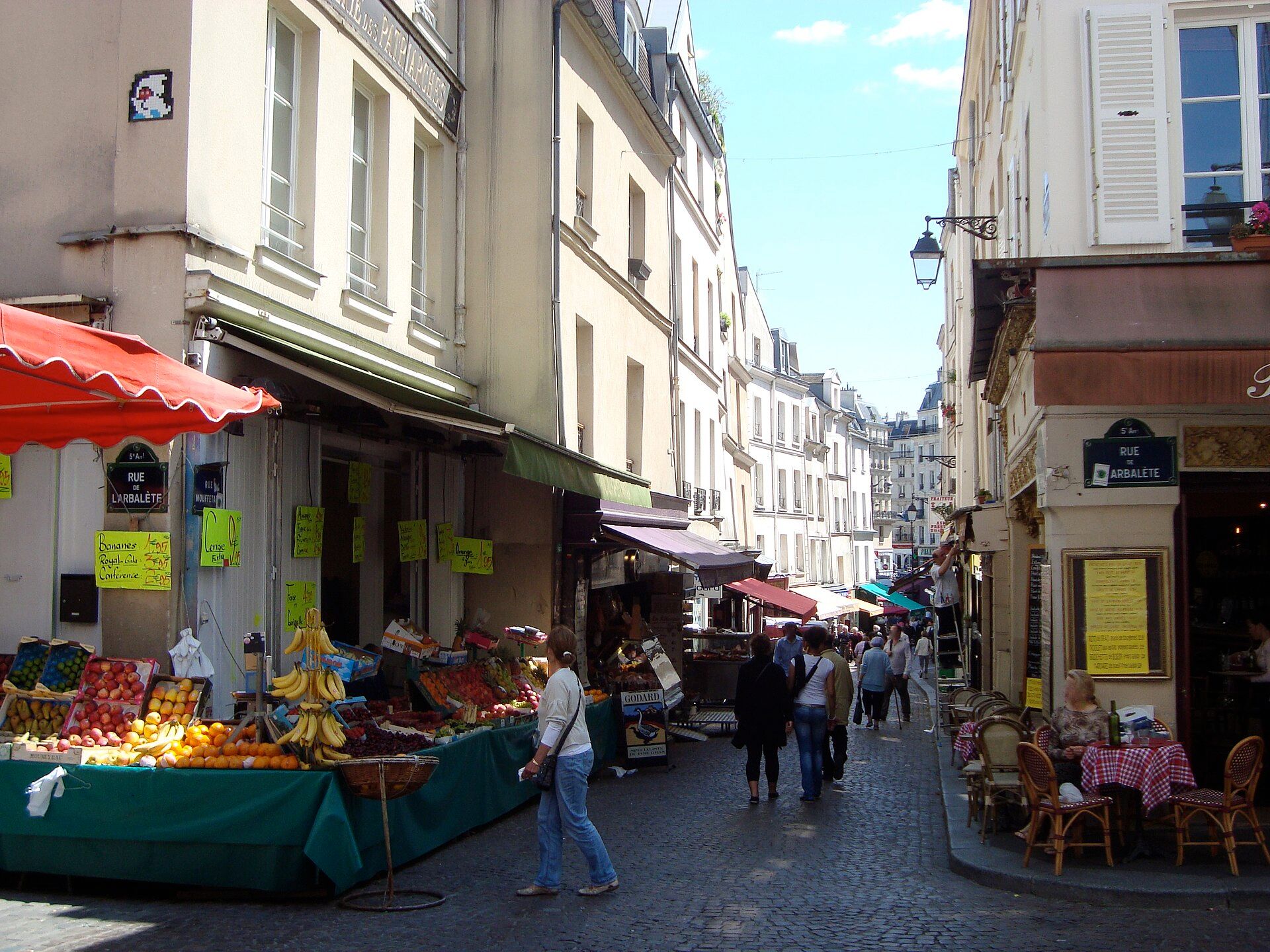
© LPLT, CC BY-SA 3.0 — Wikimedia Commons

The Mouffe, from the Contrescarpe to Saint-Médard
“La Mouffe”, its nickname, descends about 650 metres, and it is one of the oldest roads in Paris, since it takes over the line of a Late Roman route. The top of the street, near the place de la Contrescarpe (see place de la Contrescarpe), is mostly cafés and restaurants. From rue Jean-Calvin down, the food shops take over: greengrocers, cheesemongers, butchers, fishmongers and bakeries, which people loosely call the Mouffetard market.
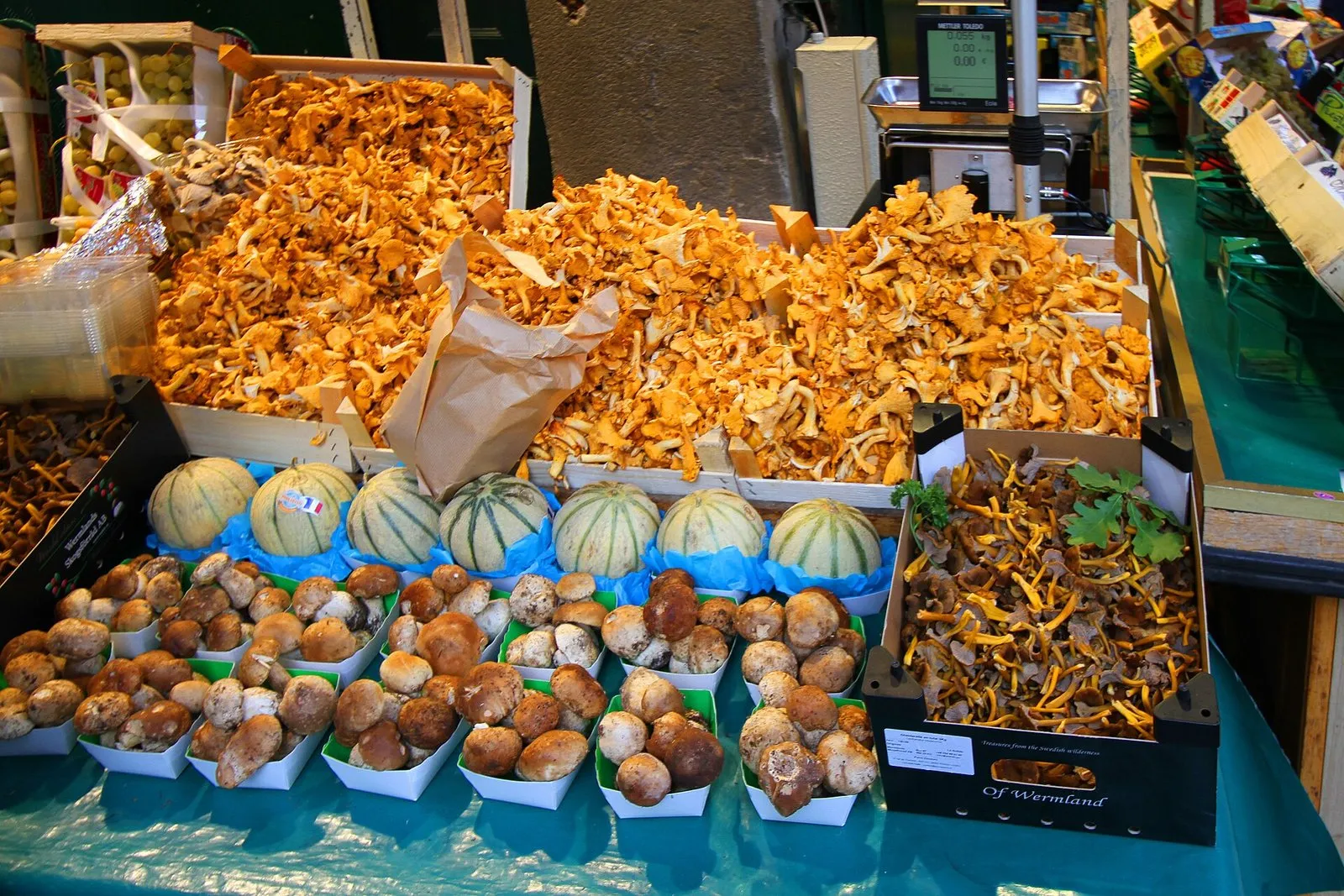
Photo: Gerd Eichmann, CC BY-SA 4.0, via Wikimedia Commons

Landmarks along the street
- No. 53. Where the 1938 coin hoard was found, according to Wikipedia.
- No. 60. The Pot-de-Fer fountain, listed in 1925, first supplied in 1624 by the Arcueil aqueduct.
- No. 69. Le Vieux Chêne, a former dance hall of 1864.
- No. 100. The L’Épée de bois art-house cinema.
- No. 134. A façade painted in sgraffito around 1930.
- No. 141. The church of Saint-Médard.
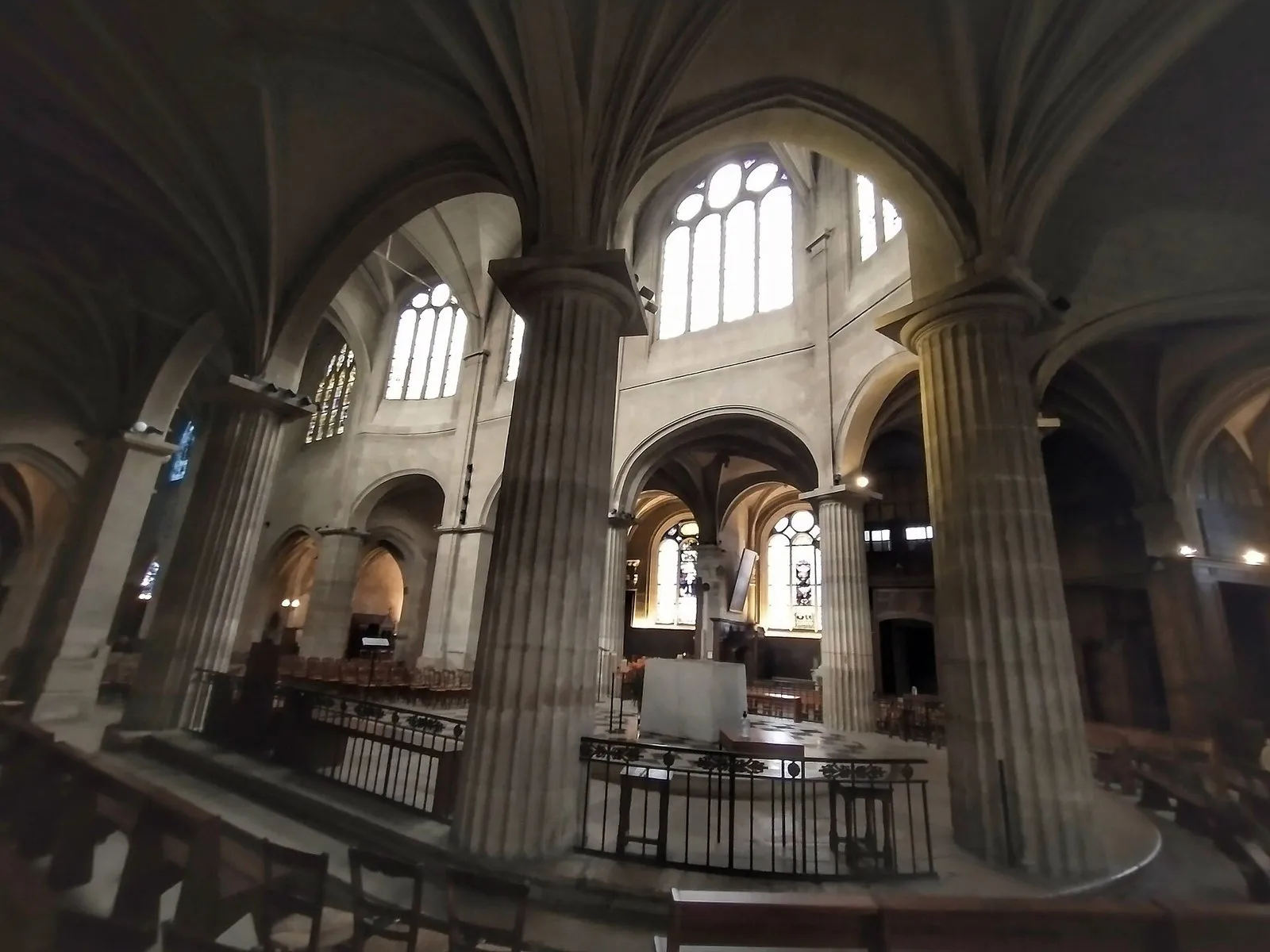
Photo: MOs810, CC BY 4.0, via Wikimedia Commons

The street appears in the cinema: in Amélie, in Julie & Julia (2009), whose market scenes were shot at the bottom of the street, and in Midnight in Paris (2011), shot on rue Édouard-Quénu and rue Pascal.
Where to sleep on the Mouffe
The hotel Apolonia Paris Mouffetard, three stars, stands about 18 metres from the middle of the street (no. 53) in our data. The others closest, in a straight line from that point, are:
- Best Western Quartier Latin Panthéon, three stars, about 215 metres.
- Hôtel des Grandes Écoles, three stars, about 216 metres.
- Hôtel Saint-Christophe, three stars, about 224 metres.
- Hôtel des Nations Saint Germain, three stars, about 244 metres.
- Hôtel Monge, four stars, about 265 metres.
- Hôtel des Arènes, three stars, about 279 metres.
Stars follow the Atout France register as recorded in our database. For the full ranking, see our list of hotels near rue Mouffetard; the street is 650 metres long, so the figures above change towards the top or the bottom. The Arènes de Lutèce are about 311 metres from the middle of the street.
History and distinctive features
- The street follows a Late Roman road that linked the Petit-Pont, by rue Descartes, to the necropolis of the future faubourg Saint-Marcel, and ended at the ford of the Bièvre, near Saint-Médard. Source : fr.wikipedia.org
- Until the mid-nineteenth century the street crossed the Bièvre by the “pont aux Tripes”. The river was covered over in the nineteenth century, and Haussmann’s works cut the street, which had been more than 1,500 m long. Source : fr.wikipedia.org
- According to Wikipedia, the demolition of a house at no. 53 in May 1938 uncovered the “treasure of rue Mouffetard”, 3,556 gold coins, mostly bearing the head of Louis XV, hidden by a barrister of the Paris Parlement. Source : fr.wikipedia.org
- The church of Saint-Médard (no. 141), built from the fifteenth to the eighteenth century and listed in 1906, was in the eighteenth century the scene of the “convulsionnaires” gathered at a deacon’s tomb; the king had the cemetery closed in 1732, which inspired the mocking inscription “By order of the King, God is forbidden to work miracles in this place”. Source : fr.wikipedia.org
- Henri Cartier-Bresson took his 1954 photograph “Rue Mouffetard, Paris”, of a smiling boy carrying two large bottles of wine, in this street. Source : en.wikipedia.org
Frequently asked questions
Is there a market on rue Mouffetard?
Not a municipal one. The food shops at the bottom of the street, from rue Jean-Calvin down, are what people call the “marché Mouffetard”, and each sets its own hours. The City’s list of open-air markets in the 5th names Port-Royal, Monge and Maubert, but no Mouffetard.
When is the nearest market open?
The marché Monge, on the place Monge, is open on Wednesday and Friday from 7 a.m. to 1.30 p.m. and on Sunday from 7 a.m. to 2.30 p.m. Port-Royal and Maubert run on Tuesday, Thursday and Saturday.
Is rue Mouffetard pedestrian?
Partly. The City announced the end of the works on 14 October 2025: between rue Ortolan and rue de l’Épée-de-Bois the street is pedestrian, repaved in grey stone and without pavements, with four pivoting barriers across some entrances, 33 cycle hoops and about 220 m² of planters. No works were found for 2026.
How long is rue Mouffetard?
About 650 metres, from the place de la Contrescarpe, at no. 1, to the church of Saint-Médard, at no. 141.
Which metro station should I use?
It depends on the end of the street. Place Monge (line 7) is about 201 metres from the middle, Cardinal Lemoine (line 10) about 256 metres from the top, at the Contrescarpe, and Censier – Daubenton (line 7) about 130 metres from the bottom, near Saint-Médard.
Why is it called Mouffetard?
The name comes from the place called “Mont-Cétard” (Mons Cetarius), which the street crossed in the thirteenth century. Another etymology, put forward in 1860, links it to the “mouffettes”, the foul exhalations.
Where did Hemingway live?
Not on rue Mouffetard but close by, at 74 rue du Cardinal-Lemoine, from August 1922 to January 1923; that street comes out on the place de la Contrescarpe, at the top of the Mouffe.