Our guides
Luxembourg Gardens, Paris
The Jardin du Luxembourg in October 2026 — opening hours that change twice a month, free entry, the Médicis fountain, the Warhol show next door and the hotels around it. Checked October 2026.
Gerda Arendt, CC0 — Wikimedia Commons

A garden bought by a queen, reshaped by Haussmann
The Luxembourg Gardens cover 25.72 hectares, of which 21.75 are open to the public. The Senate manages them at the foot of the Luxembourg Palace, between Saint-Germain-des-Prés and the Latin Quarter. The domain grew out of Marie de Médicis’s purchases, made between 1614 and 1631; Haussmann’s works gave it its present outline, and the gardens still combine a formal French layout with an English-style one. The Senate counted 6.2 million visits in 2022, a record, and the gardens hold 102 statues.
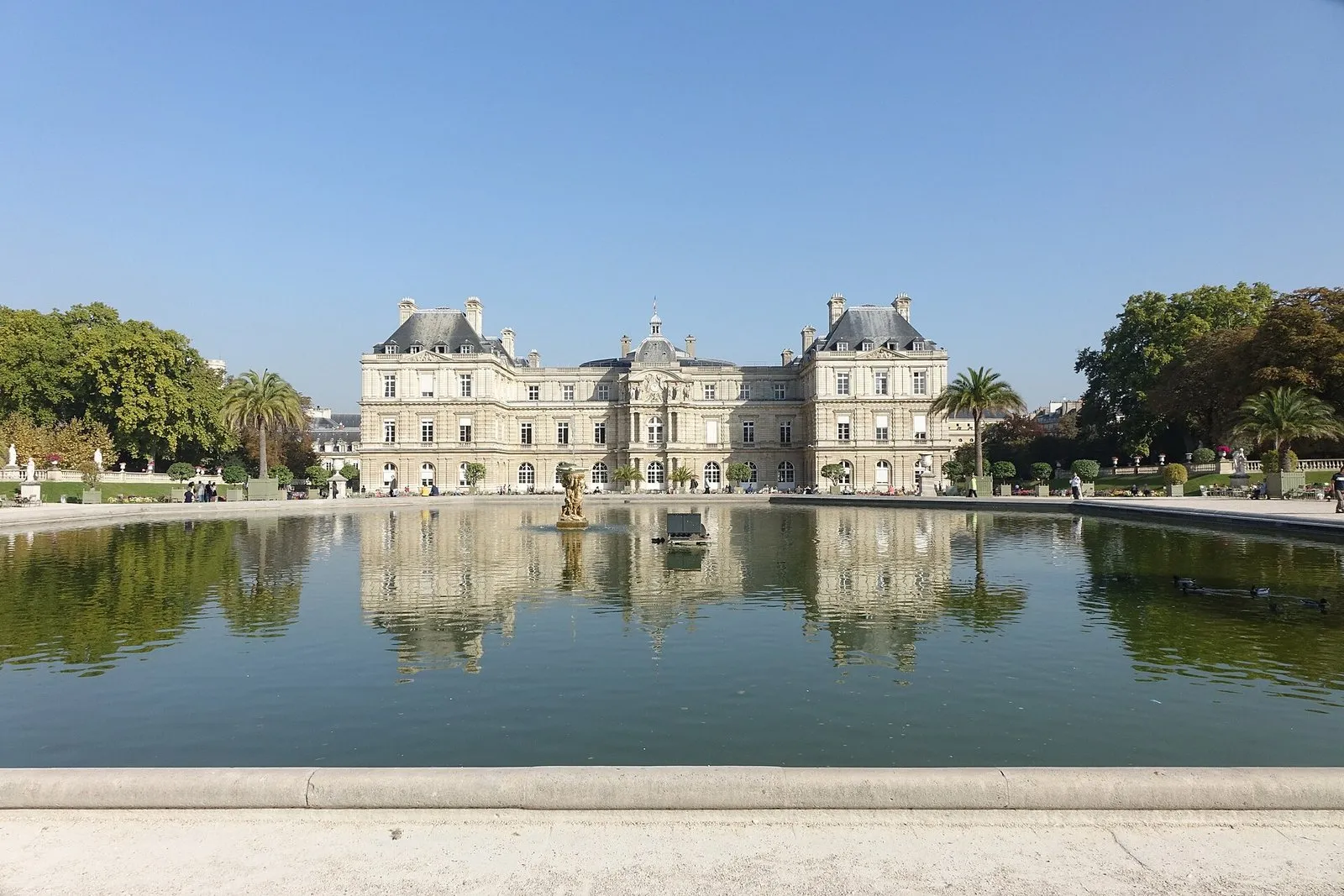
Photo: 최광모, CC BY-SA 4.0, via Wikimedia Commons

The name of a medieval ruin lives on here. The expression “aller au diable Vauvert”, to go to the back of beyond, comes from the château de Vauvert of Robert the Pious, whose ruins stood on the site and were thought cursed in the Middle Ages.
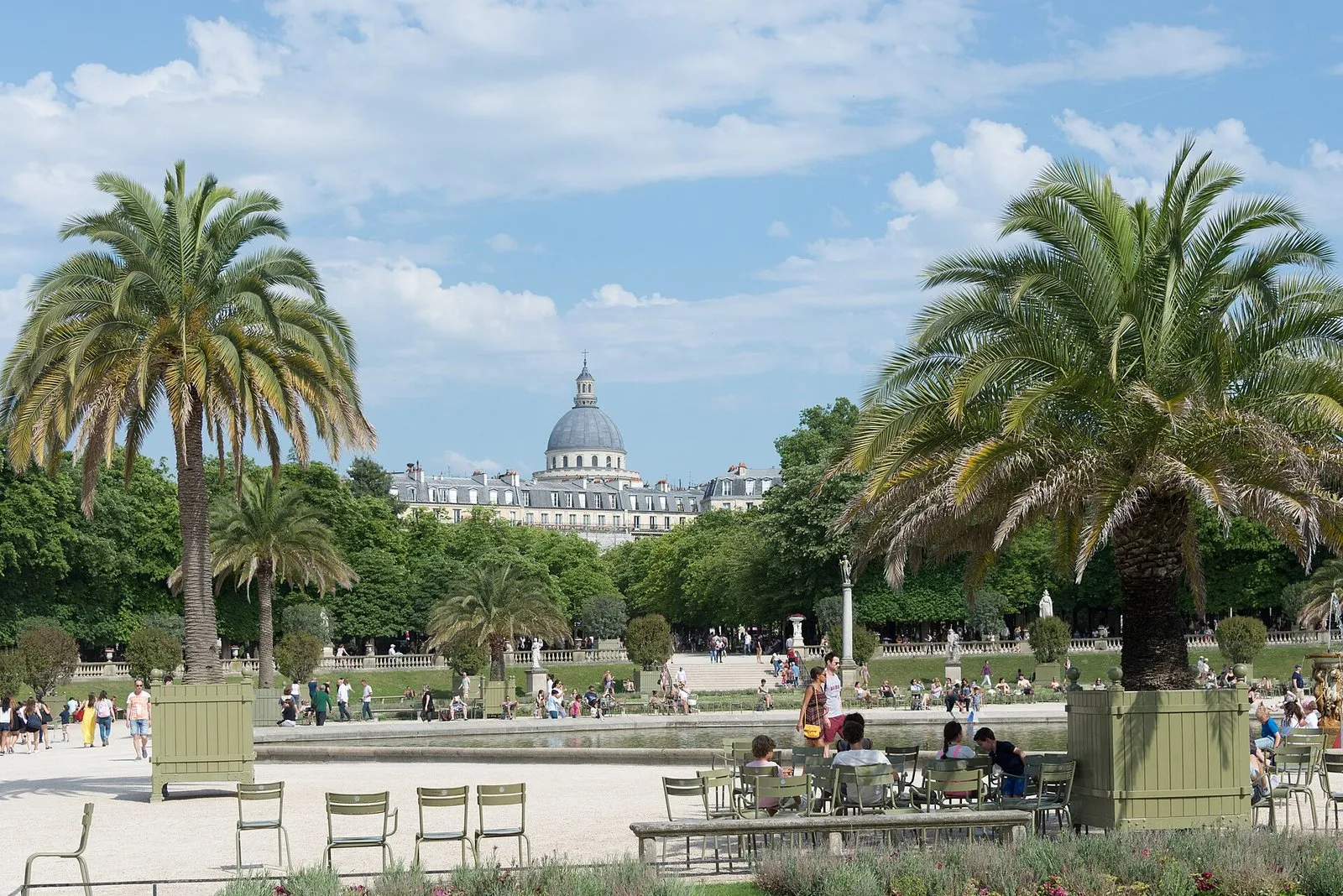
Photo: xiquinhosilva, CC BY 2.0, via Wikimedia Commons

What to see, and what is closed
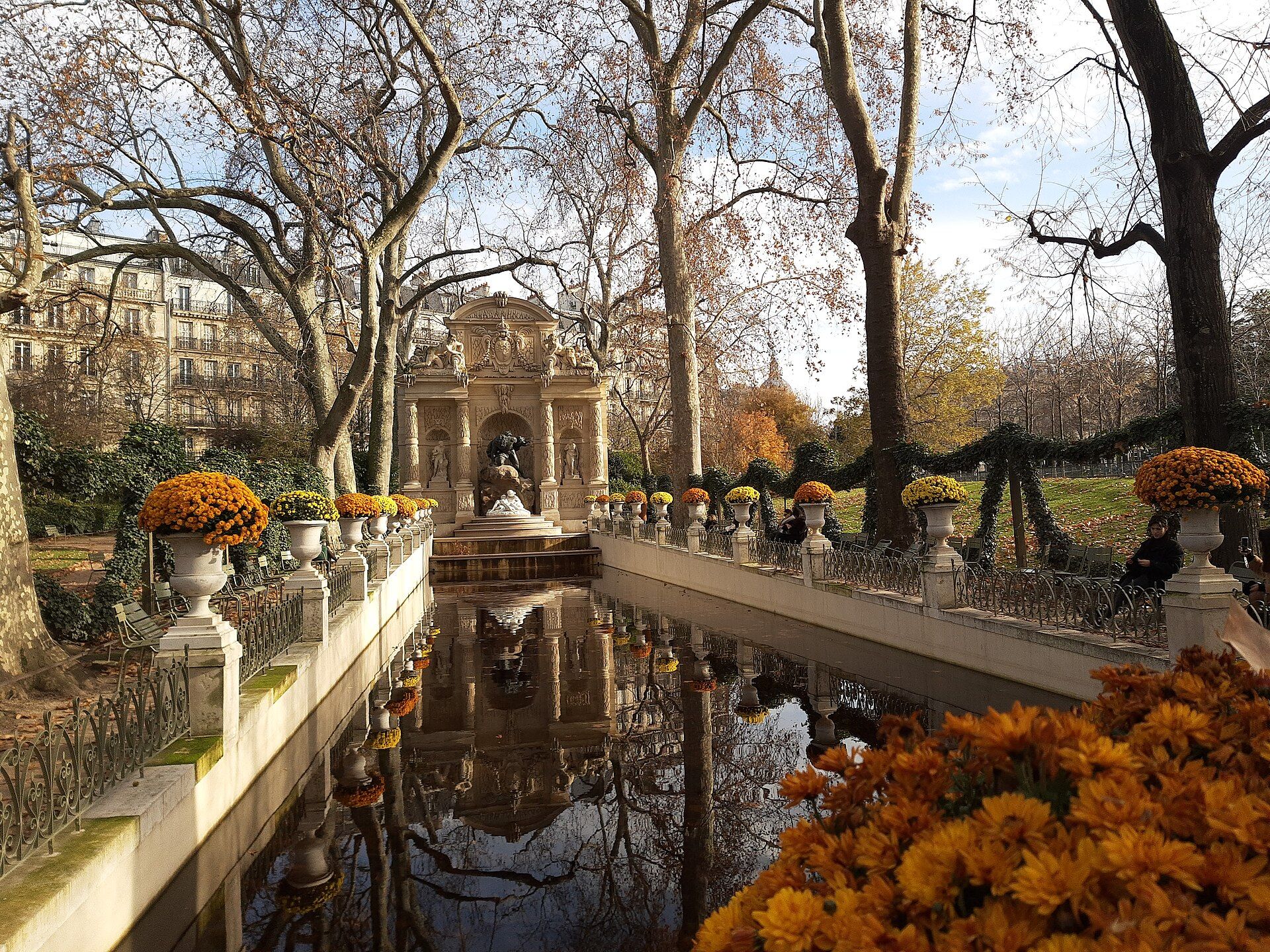
- The Médicis fountain. Built around 1630 and moved in 1862, when rue de Médicis was cut through; the photographs of the autumn show hang on the railings of that same street.
- The fruit garden and the apiary. The honey is sold at the Orangerie during the autumn exhibition.
- The Musée du Luxembourg. At 19 rue de Vaugirard, the Warhol exhibition runs until 10 January 2027. The museum, owned by the Senate and managed by GrandPalaisRmn since 2010, was, from 1750, the first museum of old art open to the public.
The gardens close well before the museum does: from 25 October the gates shut at 5.15 p.m., while the Musée du Luxembourg stays open until 7 p.m.
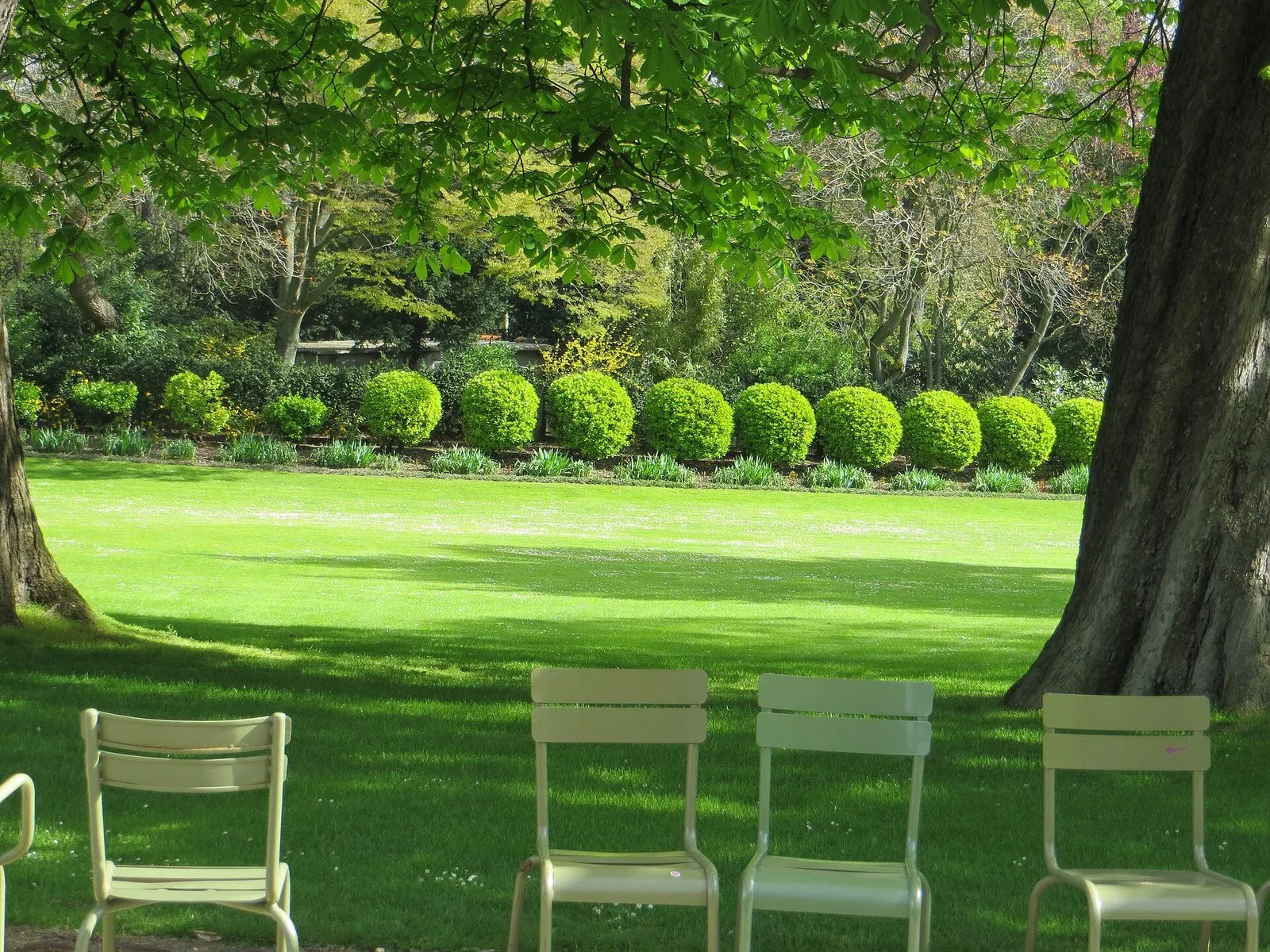
Photo: Jason Riedy, CC BY 2.0, via Wikimedia Commons

Getting there
Luxembourg (RER B) is the closest station, about 250 metres from the point we hold for the gardens, a walk of about 4 minutes by our method, which multiplies the straight line by 1.3 and walks at 80 metres a minute. The other stations are further: Odéon (lines 4 and 10) about 608 metres, Notre-Dame-des-Champs (line 12) 656, Saint-Sulpice (line 4) 662 and Mabillon (line 10) 687. The Senate’s practical page lists ten gates; the data we hold names four, on the place Edmond-Rostand, the place André-Honnorat, the rue Guynemer and the rue de Vaugirard, and the administration is at 15 rue de Vaugirard.
Choosing your moment
The opening hours move twice a month, on the 1st and the 16th, with the seasons. In summer the gates stay open until 9.30 p.m. at the latest; in December they close at 4.30 p.m. The evening of an autumn day is therefore short: once the clocks go back in late October, the gates close at 5.15 p.m. There is no weekly closing day, and entry is free by every gate.
The Senate runs a guided visit in French on some Wednesdays at 9.30 a.m., from 4 rue Auguste-Comte, by the Observatoire gates. The puppet theatre, closed for stage renovation, is announced to reopen on Sunday 18 October 2026.
What to look for
- The Médicis fountain. It dates from about 1630, was moved by around thirty metres in 1862 when the rue de Médicis was cut, and was restored by the Senate in 2020–2021.
- The fruit garden. A little over 1,000 trees on 2,100 square metres, with 379 varieties of apple and 247 of pear, continue the fruit collection of the Chartreux monks, which began about 1650.
- The apiary. The beekeeping school of the Société centrale d’apiculture has stood here since 1856; it was destroyed in 1866, restored in 1872 and rebuilt in 1991.
- Long paume. One of the oldest sports practised in France, installed in the gardens by Napoleon III in 1853, with sessions on Sundays at 10.30 a.m.
- The Statue of Liberty. A replica of Bartholdi’s “Liberty Enlightening the World” stands in the gardens, according to Wikipedia.
- The Grand Bassin. The main pond, which takes model boats, remote-controlled or under sail, according to Wikipedia.
With children, free of charge
The free activities listed by the Senate are the sandpits, chess, basketball, table tennis and boules. The chairs have been free since 1974. The paid ones, which include the playground, swings, sailing boats, carousel, ponies, puppets and tennis, have prices that the Senate does not publish.
Sleeping nearby
The hotels of our database closest to the gardens are listed below the guide. For a longer comparison, our pages on hotels near the Luxembourg Gardens and boutique hotels near the Luxembourg Gardens rank them by category; the Panthéon side is covered by a third list.
Combining it with
From the point we hold for the gardens, in a straight line; times follow our method.
| Place | Distance | On foot |
|---|---|---|
| Cluny Museum | 593 m | 10 min |
| Sorbonne | 599 m | 10 min |
| Panthéon | 631 m | 10 min |
| Saint-Étienne-du-Mont | 749 m | 12 min |
| Saint-Séverin | 790 m | 13 min |
| Place de la Contrescarpe | 943 m | 15 min |
The Musée du Luxembourg, at 19 rue de Vaugirard, is the nearest cultural stop, and the Panthéon the nearest monument, ten minutes away on foot.
Where to stay around the gardens
The section below lists the six hotels of our database nearest to the point we hold for the gardens, from 334 to 359 m in a straight line. The gardens cover 21.75 hectares open to the public, so the distance to the nearest gate can differ from these figures. The complete ranking is in our list of hotels near the Luxembourg Gardens; towards the Sorbonne, see our Sorbonne guide, and for the Odéon side, the list of hotels near the Odéon.
History and distinctive features
- The estate was bought by Marie de Médicis between 1614 and 1631 and only took its present boundaries at the end of the Second Empire, after Haussmann’s works. Source : jardin.senat.fr
- The Médicis fountain, from about 1630, was moved some thirty metres in 1862 when rue de Médicis was cut through; the Senate restored it in 2020–2021. Source : jardin.senat.fr
- The fruit garden holds a little over 1,000 trees on 2,100 m², with 379 varieties of apple and 247 of pear, and continues the Carthusians’ fruit collection begun around 1650. Source : jardin.senat.fr
- The Société centrale d’apiculture has kept a teaching apiary here since 1856; it was destroyed in 1866, re-established in 1872 and rebuilt in 1991. Source : jardin.senat.fr
- Napoleon III installed long paume, one of the oldest sports played in France, in the gardens in 1853; sessions are held on Sundays at 10.30 a.m. Source : jardin.senat.fr
Hotels near the Luxembourg Gardens
Other hotels
- Hôtel Elysa ★★★ 6 min walk · 450 m
- Le Clos Médicis ★★★ 6 min walk · 450 m
- Hôtel Les Jardins du Luxembourg ★★★★ 6 min walk · 450 m
- Hôtel Le Sénat ★★★★ 6 min walk · 450 m
- Hôtel du Brésil ★★ 6 min walk · 450 m
- Hôtel Michelet Odéon ★★★ 6 min walk · 450 m
Within 600 m as the crow flies, nearest first. Walking times are estimates: straight-line distance × 1.3, at 80 metres a minute, to the station, not to a specific exit.
Frequently asked questions
Is the Luxembourg Gardens free?
Yes. Entry is free through all the gates, and so are the chairs, which have been free since 1974. Only some activities, such as the carousel, ponies and sailing boats, are paid, at prices the Senate does not publish.
What time do the Luxembourg Gardens close in October 2026?
At 6.45 p.m. until 15 October, at 6.15 p.m. from 16 to 24 October, then at 5.15 p.m. from 25 October, once the clocks change. The gardens open at 7.45 a.m. at first, then at 8 a.m.
Which station is nearest?
Luxembourg, on the RER B, about 250 metres away. Odéon, on lines 4 and 10, is about 608 metres away, and Saint-Sulpice (line 4) about 662 metres. The Panthéon, to the east, has its own guide, the Panthéon page.
Are dogs, bicycles and scooters allowed?
Bicycles and scooters are not allowed in the gardens. Dogs are not allowed either, except on a lead in the area between the Gay-Lussac and Observatoire gates, according to the Senate’s information page.
What can I see on the railings this autumn?
“Terrains hostiles”, a free exhibition of 80 photographs on the railings along rue de Médicis, from 19 September 2026 to 17 January 2027. The railings have held two photography shows a year since 2001.
How much is the Musée du Luxembourg?
€14 at the full rate and €10 at the reduced rate, free under 16, for the “Andy Warhol. La ligne et l’image” exhibition, from 16 September 2026 to 10 January 2027. It opens daily at 10.30 a.m. and until 10 p.m. on Mondays; online booking adds €1.50.
How big are the Luxembourg Gardens?
25.72 hectares, of which 21.75 are open to the public, according to the Senate.
Who owns the Luxembourg Gardens?
The Senate, which sits in the Luxembourg Palace and manages the gardens at its foot.
Are the chairs in the Luxembourg Gardens free?
Yes, they have been free since 1974. The sailing boats, carousel, ponies, puppets and tennis are paid; the Senate does not publish their prices.
Is there a fruit garden in the Luxembourg Gardens?
Yes, a conservation orchard of a little over 1,000 trees on 2,100 square metres, with 379 apple varieties and 247 pear varieties.
Is there a guided visit of the Luxembourg Gardens?
Yes, in French, on some Wednesdays at 9.30 a.m., from 4 rue Auguste-Comte, near the Observatoire gates. The Senate publishes the dates.
Which sports are played in the Luxembourg Gardens?
Tennis, basketball, table tennis, boules and long paume, the last on Sundays at 10.30 a.m. Basketball, table tennis and boules are among the free activities listed by the Senate.