Our guides
Arènes de Lutèce, the Roman amphitheatre of Paris
The Arènes de Lutèce in the 5th — free entry, hours of the square in October 2026, how many it held, who dug it out, entrances on rue Monge, metro access and hotels at the gate. Checked October 2026.
A Roman arena in a city square
The Arènes de Lutèce are the amphitheatre of Roman Lutetia, built in the first century and rediscovered in the nineteenth. Today the stone terraces enclose a small public park in the Latin Quarter. You enter from rue Monge, at no. 49, or from rue des Arènes and the square Capitan, and nothing is charged.
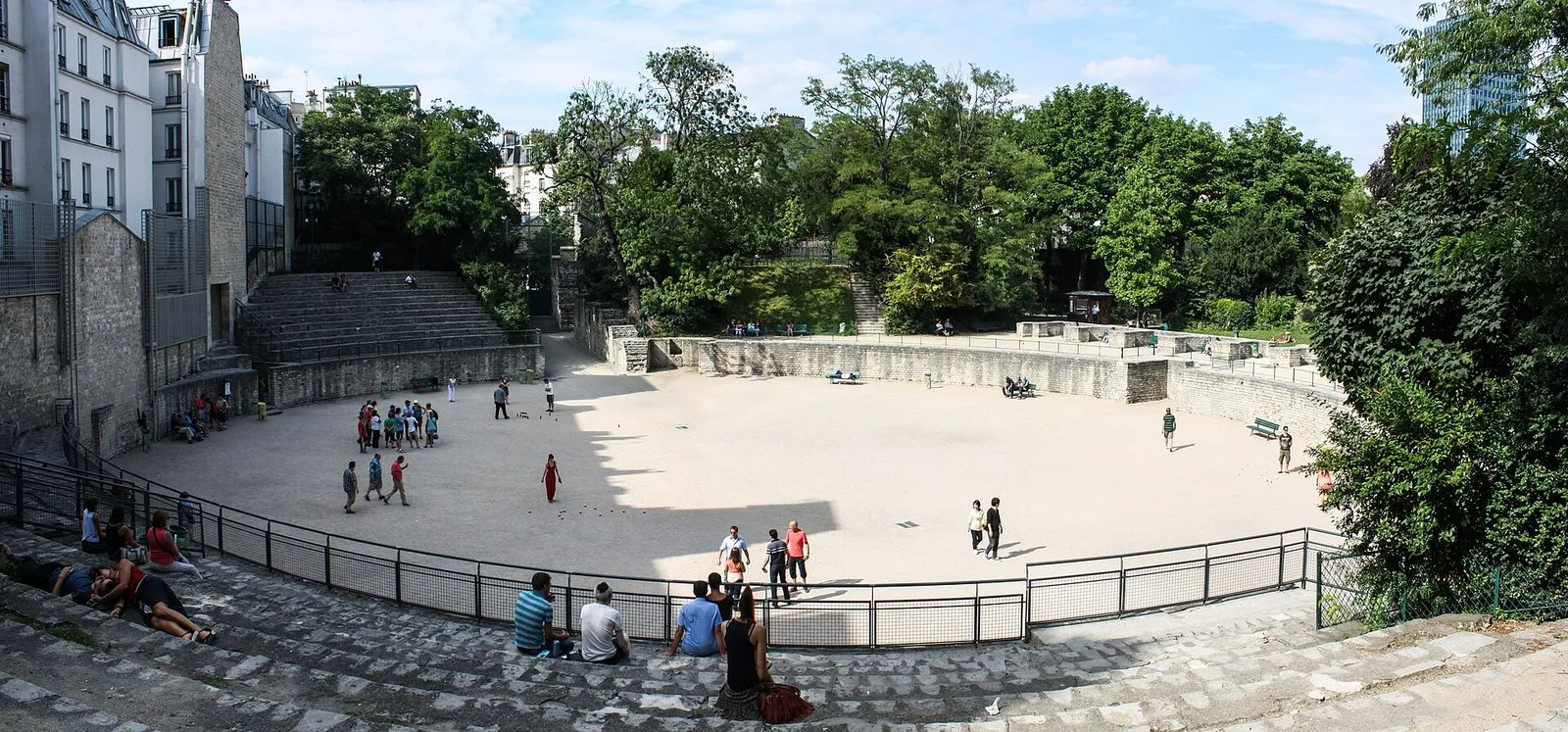
Photo: Shadowgate, CC BY 2.0, via Wikimedia Commons

The rediscovery came with the cutting of rue Monge. Théodore Vacquer excavated the arena from 1870; the site was cleared in 1883 and listed as a historic monument in 1884, and Capitan dug again in 1915. The square that bears his name followed in 1918.
How big it was
Two estimates exist. Camille Jullian’s calculation of 1922 gives about 15,944 spectators; with Jules Formigé he had proposed 17,000 four years earlier.
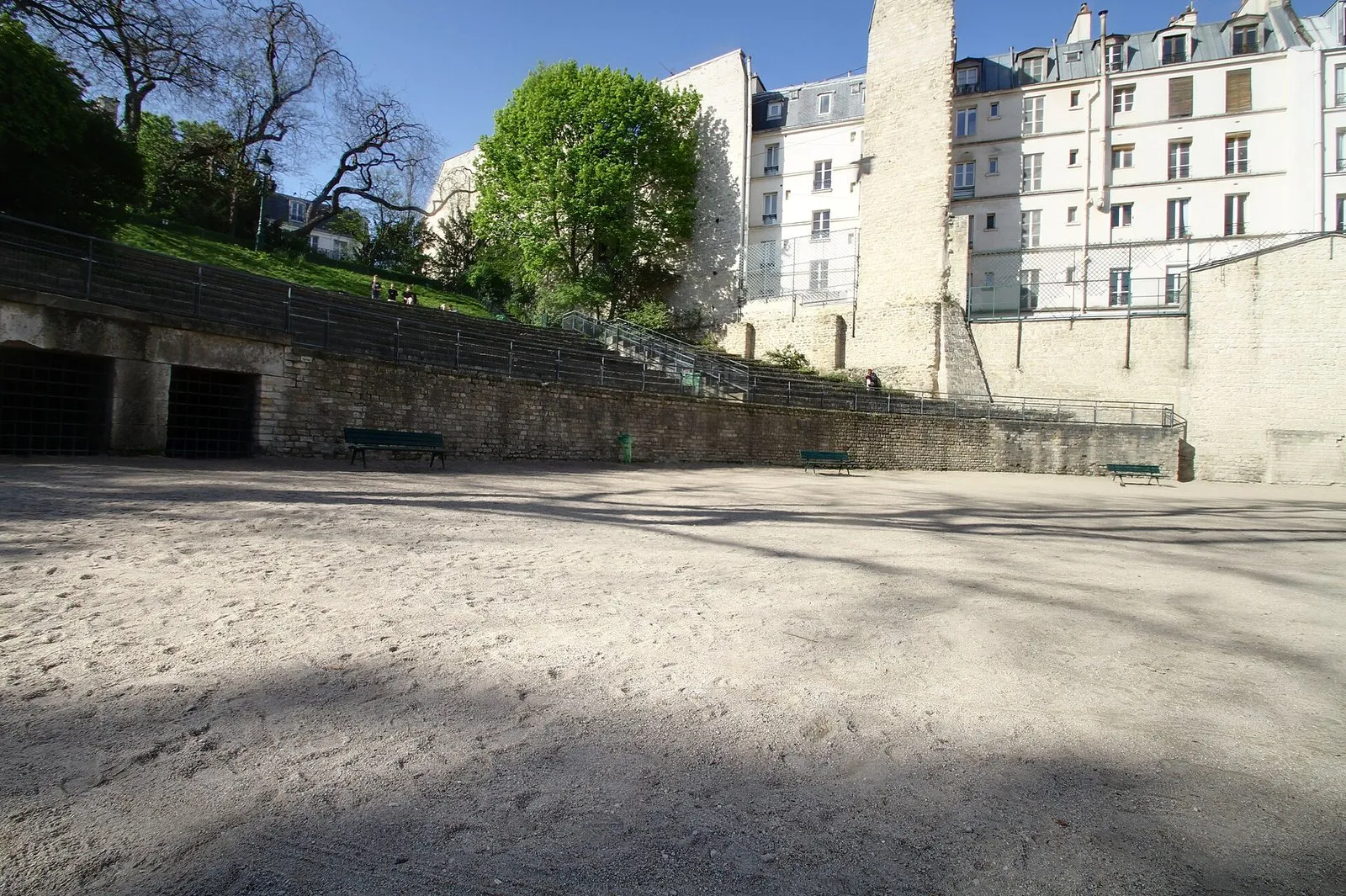
Photo: Chris Waits, CC BY 2.0, via Wikimedia Commons

Using it today
You are in a public square, not a monument with a ticket office. Children play ball on the terraces, there is a playground, and the City of Paris lists drinking-water points and a book-exchange box. The only constraint is the hours, which follow the seasons: in October 2026, 8 a.m. to 7.30 p.m. on weekdays and 9 a.m. at weekends. We keep the date because the City changes them.
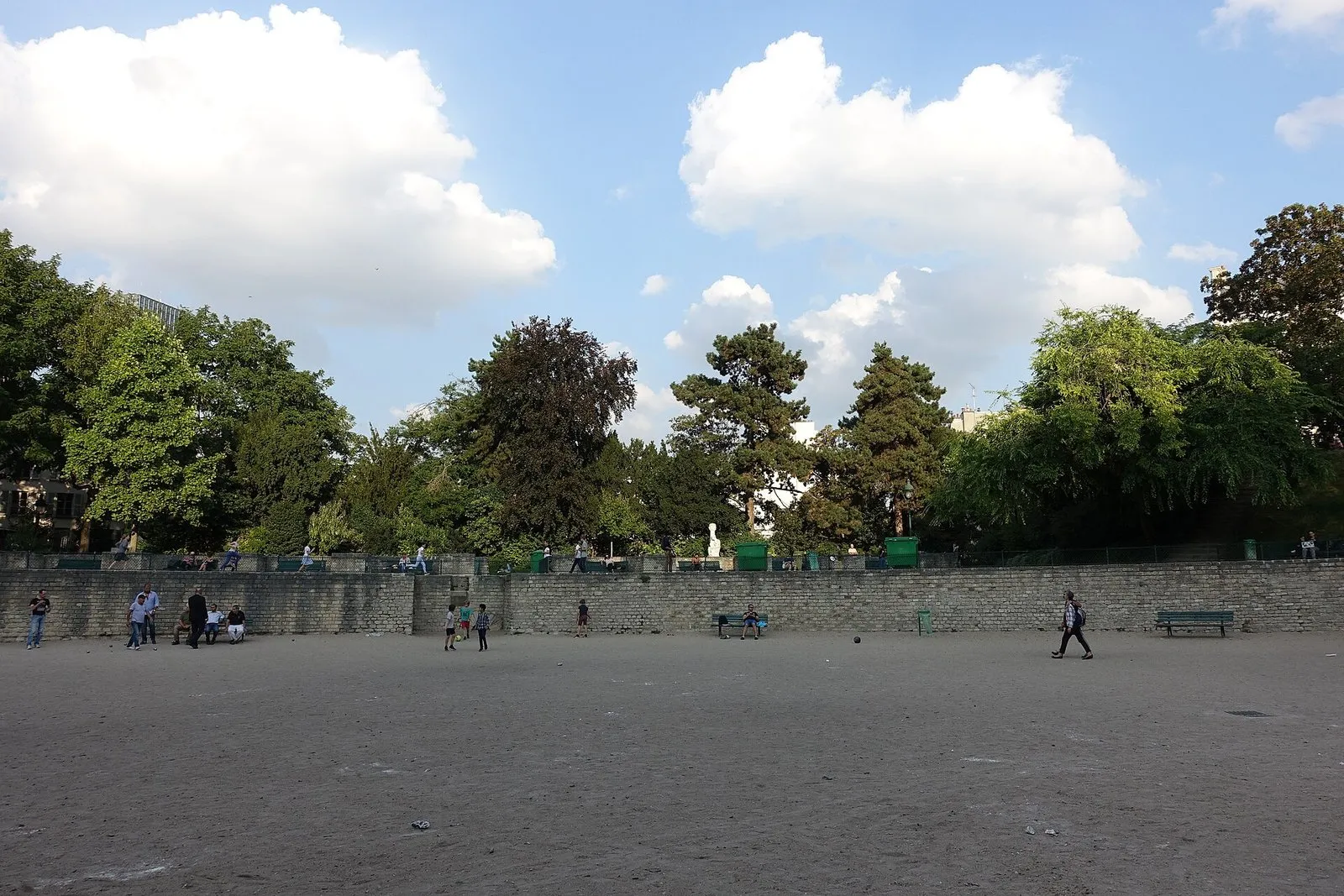
Photo: Guilhem Vellut, CC BY 2.0, via Wikimedia Commons

Getting there
The arena sits between rue Monge and rue des Arènes, on the slope of the Montagne Sainte-Geneviève. Four stations lie within about 550 metres as the crow flies: Cardinal Lemoine (line 10, 176 m), Jussieu (lines 7 and 10, 219 m), Place Monge (line 7, 253 m) and Censier – Daubenton (line 7, 548 m). At the distance of Cardinal Lemoine the walk is under three minutes by our method (direct distance × 1.3, at 80 metres a minute). Line 10 also serves Maubert-Mutualité and Cluny – La Sorbonne, so a visit can be chained with the cathedral quarter without changing trains. The rue Monge entrance, at no. 49, is the more direct one from the metro; the entrance on rue des Arènes (no. 4) is quieter and brings you out beside the square Capitan.
What to look at on the spot
The plan is that of a Gallo-Roman theatre-amphitheatre, not a pure oval arena. According to Wikipedia, the building measures about 130 by 101 metres overall; the elliptical arena is 51.8 by 44.4 metres, and the stage is 41.2 metres long. That stage is the reason for the interest of the monument: Wikipedia calls it the prototype of a theatre that combined a stage and an arena from the start, so it hosted both theatrical performances and gladiator combats. The tiers that survive on the rue Monge side are in large part a restoration, carried out between 1915 and 1918 under Julien Formigé with Louis Capitan and Charles Magne. Part of what you see is therefore twentieth-century work built on Roman foundations.
From Roman ruin to public square
The arena went out of use probably from the third century, and its remains were later buried under the fill of the wall of Philippe Auguste. Nothing was known of them in the nineteenth century until the works for rue Monge exposed the upper tiers in 1867 and 1868. In 1870 the Compagnie générale des omnibus, which had acquired the land, brought more of the structure to light. The city council voted to preserve it in 1883, by 36 votes to 23. The square des Arènes was created in 1892, and the building was bought back from the omnibus company in 1915 and 1916, before the restoration of 1915 to 1918. Basketball matches were played there from 1926 to 1951, and today the arena also serves for performances and games of pétanque, according to Wikipedia. We read the opening hours on the City of Paris page on 4 October 2026; check them again before a visit in winter or summer.
Choosing your moment
Opening is free and there is no queue, so the only choice is the time of day. The gates open at 8 a.m. on weekdays and at 9 a.m. at weekends in the period we checked, and close at 7.30 p.m. Because the square is a public garden, it is usually not a place for a long stay: allow 20 to 30 minutes for the arena, more if you want to sit. There is a playground and there are drinking-water points, which makes it a practical stop with children between the Panthéon and the Jardin des Plantes.
Combining it with other visits
Distances are as the crow flies from the arena, and walking times follow the site’s method.
- Place de la Contrescarpe: 224 metres, about 4 minutes on foot.
- Rue Mouffetard: 282 metres, about 5 minutes.
- Saint-Étienne-du-Mont: 398 metres, about 6 minutes.
- Grand Mosque of Paris: 406 metres, about 7 minutes.
- Natural History Museum: 442 metres, about 7 minutes.
- Panthéon: 492 metres, about 8 minutes.
- Institut du Monde Arabe: 542 metres, about 9 minutes.
- Jardin des Plantes: 559 metres, about 9 minutes.
All eight are within about nine minutes of the arena on foot, so the square can open or close a day on the Montagne Sainte-Geneviève.
Where it sits in Roman Lutetia
The arena stood on the edge of the Roman city. According to the district’s history that we hold, Lutetia spread around a forum under today’s rue Soufflot, and its north–south axis, the cardo, follows rue Saint-Jacques and boulevard Saint-Michel. Excavations on rue Cujas in 2022 found the first traces of a residential quarter laid out under Augustus (27 BC to AD 14), with thousands of oyster shells. The arena, dated to the end of the first or the beginning of the second century, therefore belongs to the later city. Our guide to the history of the Latin Quarter sets it beside the baths at Cluny.
A place for a hotel stay
Of the 110 hotels in our data, the nearest to the amphitheatre is the Hôtel des Arènes, about 42 metres away as the crow flies, measured to the point we hold for the arena; the Hôtel Monge is 45 metres, the Hôtel des Nations Saint-Germain 68 metres, the Best Western Quartier Latin Panthéon and the Hôtel Saint-Christophe 163 metres each, and the Hôtel des Grandes Écoles 176 metres. The block below lists the others within a few minutes’ walk.
A little further, the place de la Contrescarpe is about 260 metres away; the wider area is covered in our guide to hotels near rue Mouffetard.
History and distinctive features
- The arena could hold about 15,944 spectators by Camille Jullian’s calculation of 1922; Jullian and Jules Formigé had estimated 17,000 in 1918. Source : fr.wikipedia.org
- Rediscovered when rue Monge was cut through, the arena was excavated by Théodore Vacquer from 1870 and again by Capitan in 1915; the square Capitan dates from 1918. Source : fr.wikipedia.org
- The monument has been listed as a historic monument since 1884. Source : fr.wikipedia.org
- The square has a playground, drinking-water points and a book-exchange box, according to the City of Paris. Source : paris.fr
Hotels near the Arènes de Lutèce
Some links are affiliate links: if you book through them, we may earn a commission, at no extra cost to you. How we are paid
Other hotels
- Hôtel des Arènes ★★★ 1 min walk · 50 m See availability
- Hôtel Monge ★★★★ 1 min walk · 50 m See availability
- Hôtel des Nations Saint Germain ★★★ 1 min walk · 100 m See availability
- Hôtel Saint-Christophe ★★★ 3 min walk · 200 m See availability
- Best Western Quartier Latin Panthéon ★★★ 3 min walk · 200 m See availability
- Hôtel des Grandes Écoles ★★★ 3 min walk · 250 m See availability
- Hôtel du Jardin des Plantes ★★★ 3 min walk · 250 m See availability
- Paris Art Hotel ★★★ 4 min walk · 350 m See availability
Within 450 m as the crow flies, nearest first. Walking times are estimates: straight-line distance × 1.3, at 80 metres a minute, to the station, not to a specific exit.
Frequently asked questions
Are the Arènes de Lutèce free?
Yes. The square is open and free, with no ticket and no booking.
What are the opening hours of the Arènes de Lutèce?
From 1 to 24 October 2026, 8 a.m. to 7.30 p.m. on weekdays and 9 a.m. to 7.30 p.m. at weekends. The hours change with the season.
How old are the Arènes de Lutèce?
The amphitheatre of Lutetia dates from the first century. It was cleared in 1883 and listed as a historic monument in 1884.
How many people did the Arènes de Lutèce hold?
About 15,944 by Camille Jullian’s calculation of 1922. In 1918, Jullian and Jules Formigé had put it at 17,000.
Where is the entrance to the Arènes de Lutèce?
At 49 rue Monge, or by rue des Arènes (no. 4) and the square Capitan.
Can children play there?
The square has a playground, and children play ball on the terraces of the arena, according to Wikipedia.
Which metro station is nearest?
Cardinal Lemoine on line 10, about 176 metres away, then Jussieu (lines 7 and 10), about 219 metres, and Place Monge (line 7), about 253 metres.
How big are the Arènes de Lutèce?
About 130 by 101 metres overall, with an elliptical arena of 51.8 by 44.4 metres and a stage 41.2 metres long, according to Wikipedia.
Were gladiators ever shown at the Arènes de Lutèce?
Wikipedia describes the building as both a theatre and an amphitheatre, used for theatrical performances and gladiator combats.
How long should I allow for a visit?
About 20 to 30 minutes for the arena itself. The square has a playground and water points, so families may stay longer.
Which sights are within ten minutes’ walk?
The place de la Contrescarpe, rue Mouffetard, Saint-Étienne-du-Mont, the Grand Mosque, the Natural History Museum, the Panthéon, the Institut du Monde Arabe and the Jardin des Plantes, all within about 560 metres as the crow flies.